中和
Balanced Chart
Strength
- Balance · stability
- Flexible with luck
- Rare ideal
In brief
A state neither strong nor weak — the ideal a chart aspires to.
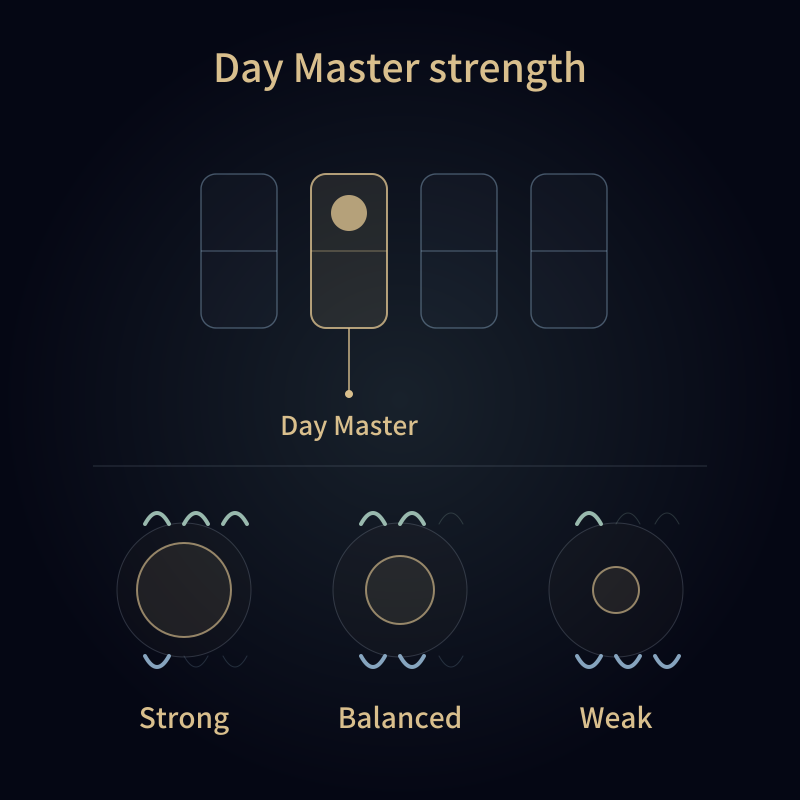
A conceptual illustration of traditional Bazi, not a personal useful element, score or measured element ratio. The useful element is not simply the least abundant element.
A concept map of the month branch, roots, other stems and element distribution used to assess Day Master strength. The three states are not ranks or personal scores. Following and transformation structures are read differently from ordinary balancing.
What is the Balanced Chart?
Balance (中和) is a state where the Day Master and its surroundings are evenly poised, not tilted one way — the vessel most prized in Bazi. Not swayed by any single energy, it adapts flexibly to the changes of luck. Yet perfect balance is rare; most charts lean slightly toward strong or weak, and correcting that lean is the role of the Useful God.
How to read it
The less the lean, the less a chart depends on one Useful God, and the more evenly it takes whatever luck comes.
Frequently asked
- What is the Balanced Chart (中和) in Bazi?
- A state neither strong nor weak — the ideal a chart aspires to. Balance (中和) is a state where the Day Master and its surroundings are evenly poised, not tilted one way — the vessel most prized in Bazi. Not swayed by any single energy, it adapts flexibly to the changes of luck. Yet perfect balance is rare; most charts lean slightly toward strong or weak, and correcting that lean is the role of the Useful God.
- Why does the Balanced Chart matter in a reading?
- Key points: Balance · stability, Flexible with luck, Rare ideal. The less the lean, the less a chart depends on one Useful God, and the more evenly it takes whatever luck comes.
Related concepts
See your Day Master’s strength and Useful God — from your birth date and time.
Read my Bazi chart →