Four Pillars of Destiny · 四柱
Four Pillars of Destiny, explained for beginners
Eight characters, one chart: how BaZi turns a birth moment into a readable structure.
The short answer
Four Pillars of Destiny — BaZi (八字, 'eight characters') — is the classical Chinese system that encodes your birth year, month, day and hour as four pairs of calendar characters, then reads personality and timing from the balance of five elements and the relationships among those eight characters. The day stem, called the Day Master, represents you; the other seven characters describe the forces around you; and ten-year luck pillars extend the chart across a lifetime. The calculation is deterministic calendar mathematics — the interpretation is a traditional lens for reflection, not a verdict.
The four pillars: what each one holds
BaZi means “eight characters”. Your birth year, month, day and hour each become one pillar — a pair of characters drawn from the ten Heavenly Stems and twelve Earthly Branches of the Chinese calendar. Four pillars, two characters each: eight characters in total. Each pillar is traditionally read as one region of life.
Enlarge diagram
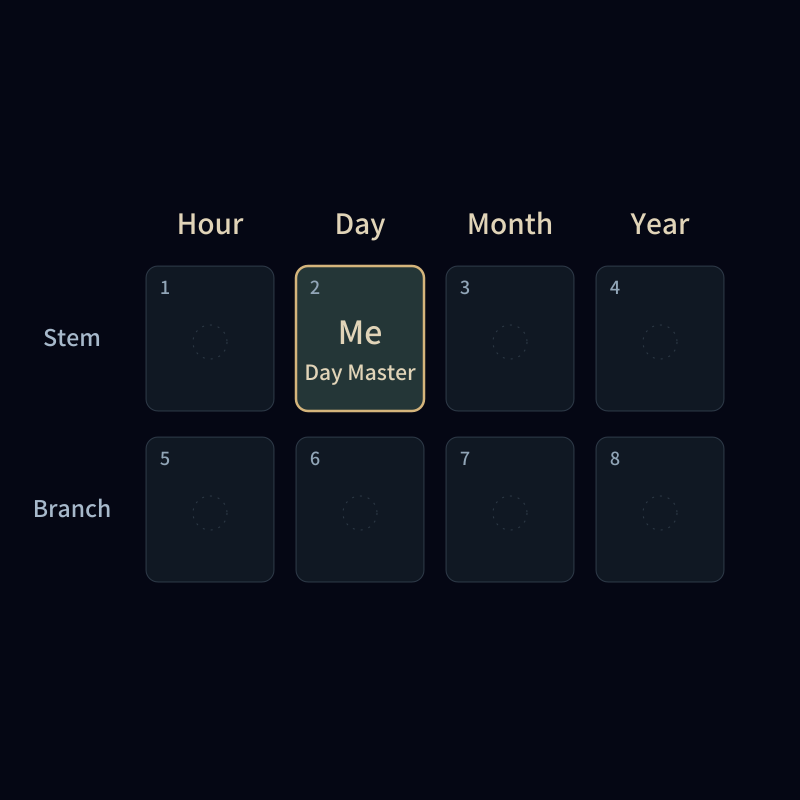
Empty Four Pillars chart — hour, day, month, year
Left to right: hour, day, month, year — the same order as the live chart. Top row stems, bottom row branches. The thick cell is the Day Master. No one's chart is written in.
- 1. Hour stem
- 2. Day stem · Day Master
- 3. Month stem
- 4. Year stem
- 5. Hour branch
- 6. Day branch
- 7. Month branch
- 8. Year branch
年柱Year pillar
The broadest context: generation, family background, early environment — the era you were born into. This is also where the Chinese zodiac animal lives (it is simply the year's Earthly Branch). The year does not change on January 1 but at Start of Spring (立春), the solar term that opens the year in early February.
月柱Month pillar
The seasonal climate of the chart: parents, upbringing, career environment. Because it captures the season of birth, the month pillar carries the most weight in judging which elements are strong or weak. Month boundaries fall at solar terms — astronomical moments, not calendar dates.
日柱Day pillar
The self and one's closest relationships. Its stem is the Day Master — the reference point for the entire reading. Traditionally the day branch is also read for marriage and the inner life.
時柱Hour pillar
Ambitions, later life, children — and the finest-grained pillar. It changes every two hours, which is why an accurate birth time matters more in BaZi than in most Western astrology practice.
The Day Master: the character that means “you”
Of the eight characters, one is special: the stem of the day pillar, called the Day Master (日主). It is one of ten possibilities — each of the five elements in a yang or yin form, so a Yang Wood person, a Yin Fire person, and so on. Everything else in the chart is read relative to it. A character that produces your Day Master’s element plays a supporting, resource-like role; one that controls it plays a disciplining role; one that matches it stands beside you as a peer. These relative roles are the Ten Gods — the working vocabulary of BaZi personality reading. The recurring pattern the Ten Gods form around the Day Master is the chart’s structure (格局), something like its overall grain.
Five-element balance: the chart’s bookkeeping
Every stem and branch carries one of the five elements — Wood, Fire, Earth, Metal, Water — and the branches additionally conceal “hidden stems” that count toward the tally. Add it all up and you get the chart’s elemental balance sheet: which elements are abundant, which are scarce, which are absent. A reading then asks whether the Day Master is strong or weak in that landscape, and which element would best correct the lean — the Useful God (用神), the pivot of classical interpretation. Alongside this backbone, tradition also marks certain stem-branch combinations as symbolic stars — named motifs like the Peach Blossom or the Traveling Horse that add color to a reading.
Luck pillars: life in ten-year chapters
The natal chart is fixed, but BaZi extends it through time with luck pillars (大運): a sequence of stem-branch pairs, each governing roughly ten years of life. The sequence is derived from your month pillar — running forward or backward through the calendar cycle depending on your birth year’s polarity and your gender — and the age at which the first pillar begins comes from the days between your birth and the solar term in that direction of travel (the next term if the sequence runs forward, the previous if backward), three days counting as one year. Each decade, in effect, adds two temporary characters to your eight, shifting the elemental climate you operate in. Annual pillars do the same at year scale. This is where BaZi’s timing questions live: not “what will happen”, but “what kind of decade is this for a chart like mine”.
The calculation is deterministic — and that’s the point
Everything above is calendar mathematics with exactly one right answer. Year and month boundaries fall at the 24 solar terms — astronomical moments when the sun reaches a defined ecliptic longitude, different each year. Because a solar term is a single instant for the whole planet, careful practice judges the year and month pillars on standard clock time, which encodes that instant faithfully. The day and hour pillars live on a different clock: they follow apparent solar time — your clock time adjusted by four minutes per degree of longitude from your time zone’s standard meridian, plus the equation of time, plus any historical quirks of your birthplace’s civil clock (time-zone changes, daylight saving) — because the twelve double-hours are positions of the local sun. That correction can move the hour pillar — and near midnight, the day pillar. The takeaway for a newcomer: given the same birth data, every competent BaZi calculation should produce the same eight characters, and you can check them against any published almanac. Interpretation is where perspectives differ; the chart itself is not a matter of opinion.
To be equally honest about the other side: deterministic calculation does not make BaZi a science. Neither BaZi nor any divinatory system has empirical validation. Its value is as a structured mirror — a vocabulary for temperament and timing that you weigh against your own experience. If you come from Western astrology, the comparison in BaZi vs Western Astrology maps the two systems side by side.
Frequently asked questions
- Do I need my exact birth time for a Four Pillars reading?
- For the full chart, yes — the hour pillar changes every two hours, and near midnight the day pillar itself can shift depending on the solar-time correction. If you don't know your birth time, the year, month and day pillars still give a meaningful reading of element balance and temperament; the chart just loses the resolution the hour pillar provides (traditionally: ambitions, later life, children).
- Is Four Pillars the same as the Chinese zodiac?
- The zodiac is one-eighth of it. Your zodiac animal is simply the Earthly Branch of the year pillar — one of the eight characters. A Four Pillars reading uses all eight, plus the hidden stems inside each branch, so two people with the same zodiac animal usually have very different charts.
- How are luck pillars calculated?
- Deterministically, from the natal chart. The sequence starts from the month pillar and runs forward or backward through the sexagenary cycle depending on the year stem's polarity and your gender; the starting age comes from counting the days from your birth to the solar term in the direction of travel — the next term ahead if the sequence runs forward, the previous one if it runs backward — with three days converting to one year of age. Same birth data, same luck pillars, and the direction rule (men born in yang years and women born in yin years run forward) is shared across mainstream practice.
Go deeper
Five Elements (五行)
Wood, Fire, Earth, Metal, Water — characters and cycles.
Ten Gods (十神)
The ten relative roles around the Day Master.
Structures (格局)
The chart's overall grain and its named patterns.
Fundamentals (用神)
Day Master strength and the Useful God.
Symbolic Stars (神殺)
Peach Blossom, Traveling Horse and other named motifs.
BaZi vs Western Astrology
What each system actually reads — an honest comparison.
Want to see your own four pillars, computed with true solar time?
Read my BaZi chart →BaZi is a traditional East Asian interpretive framework, offered here for reflection. It does not replace medical, legal or financial advice.