Contextual persona
Contextual Persona 面
At work · In social settings · In close bonds — three faces of one person
In short
A contextual persona reads how the same person shows up across three settings: work, wider social life, and close bonds. It does not split you into three personalities — it looks at how one personality (the CORE-8 eight axes) surfaces differently depending on the room. When the three read broadly alike we call it a consistent type; when one axis splits sharply by context, a divergent type. In the five-thread narrative, bonds and role are not separate threads but exactly this: the face the self shows when it meets a context.
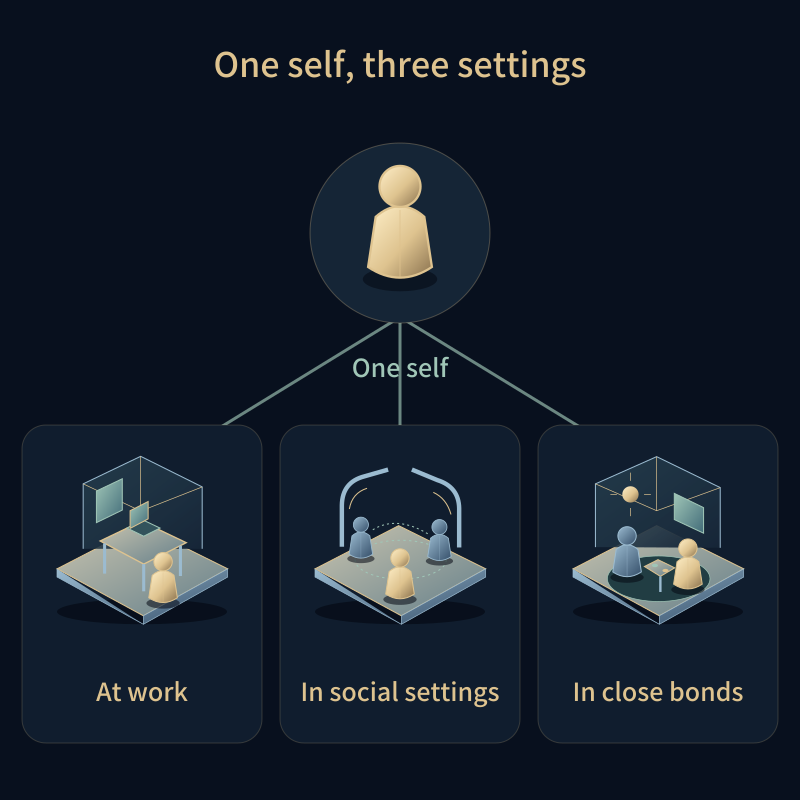
Three rooms
The survey questions are grouped into three contexts from the start. Because the same eight axes are measured separately in each room, we can compare how far one axis shifts by setting — without making you sit three different tests.

職At work
The face you wear where work and results are at stake — which grain comes forward inside relationships with clear roles and duties.
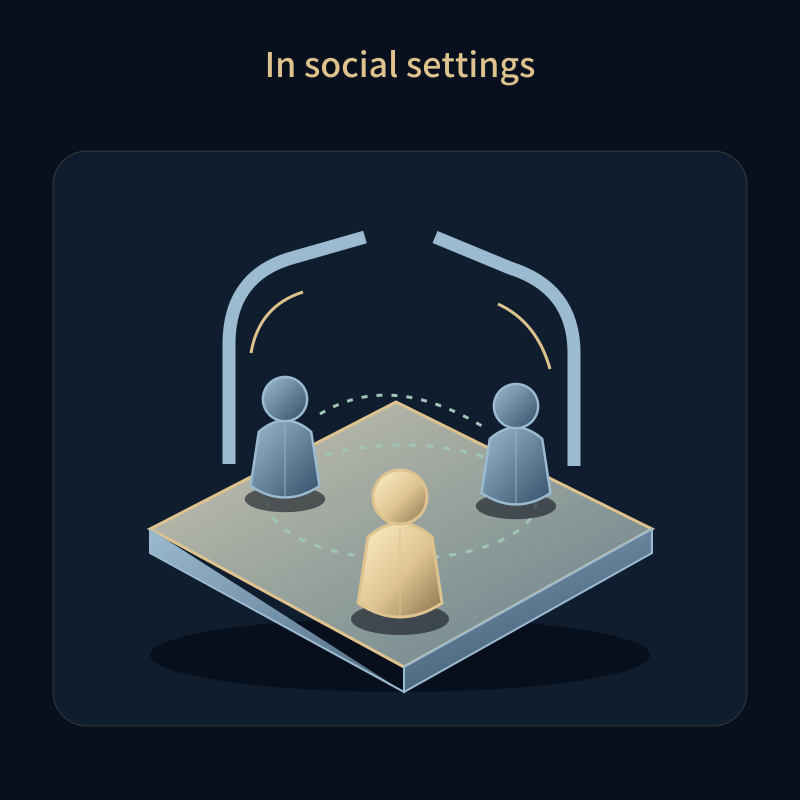
社In social settings
The face you wear in the loosely connected outside world — what grain you show among people you are not yet close to.
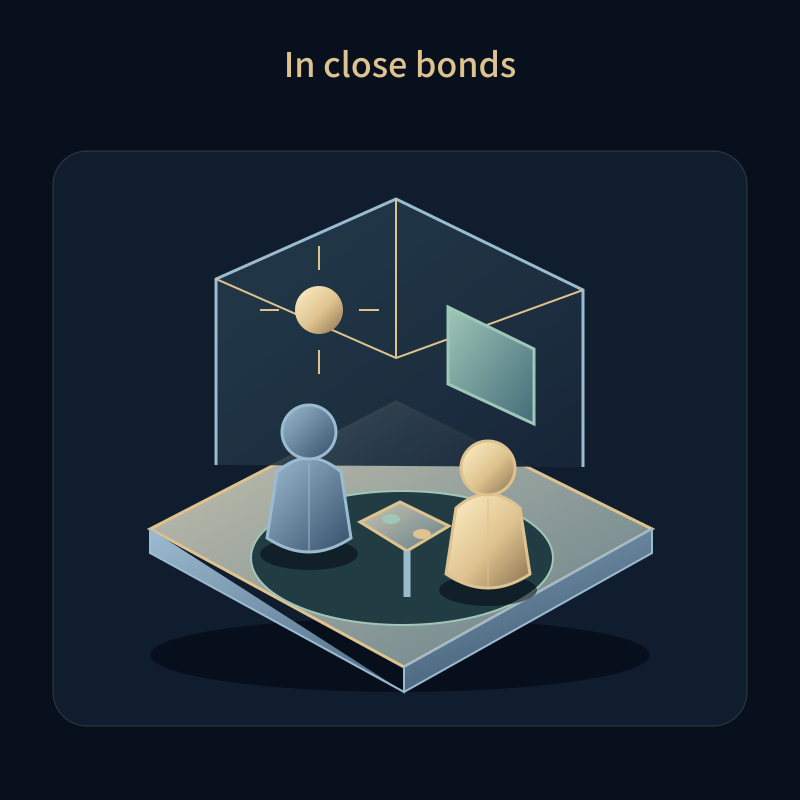
緣In close bonds
The face you wear before those close to you — the grain that surfaces differently once your guard is lowered.
The eight axes and their poles
Each contextual face is written in the words of these eight axes. Neither pole is better than the other; they only say where a person stands on that axis.
PrinciplePrinciple ↔ Flexibility
How firmly you hold to what you have committed to — not a taste for planning, but the strength with which social agreements and principles are kept.
UtilityPragmatism ↔ Idealism
Where the weight of your judgement falls — not a matter of cold versus warm, but the size of the instinct that weighs gain, loss and what actually works.
ModestyModesty ↔ Boldness
How much of yourself you put forward — the balance between stepping back and stepping up.
ConfidenceConviction ↔ Prudence
How much you trust your own judgement — not whether your energy turns outward, but the size of your certainty about yourself.
StabilitySteadiness ↔ Dynamism
How little outside stimulus moves you — the density with which your feeling holds an even keel.
AmbitionAmbition ↔ Contentment
How much further you want to go — not imagination, but the size of the desire to actually achieve.
VulnerabilitySensitivity ↔ Resilience
How keenly you register a crisis — anxiety and sensitivity read not as weakness but as the resolution of your perception.
EmpathyEmpathy ↔ Detachment
How far you read and take in another's feeling — both the 'intelligence' that reads it and the 'stance' that receives it.
How a face is derived
Raw context scores are never compared directly. Each context stimulates a different mix and volume of axes, so comparing raw totals would attach a label to certain contexts even for someone answering at random. That is a face made by the item structure, not by the person.
So we subtract the expected value of the exact item set the person answered (centering), divide by the amplitude those items allow (normalising), and keep only the signal the person made. Then, per context, we take the axes that stand out most against that person's own three-context average — the comparison is with themselves, not with other people.
Finally, if the deviation does not clear a minimum size, no label is made and the context is left 'even'. After centering, 'always the top two' would simply be noise.
Consistent and divergent
We look at the widest spread between contexts on any single axis and write one of two. Neither is better.
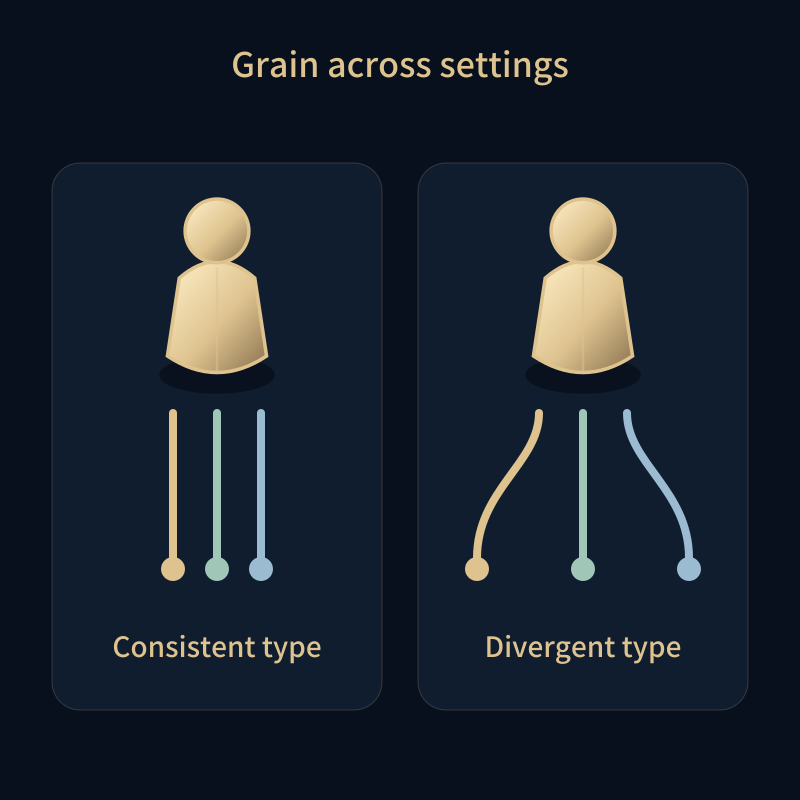
Consistent type
Someone whose grain is broadly the same across all three contexts. A similar face everywhere makes you predictable and coherent, though there may be less room to adjust to the room you are in.
Divergent type
Someone for whom one axis splits sharply by context. Wearing a different face per role brings high adaptability, though the question of which one is 'really me' can wear on you.
Where this sits in the five-thread narrative
The integrated narrative reads a person as four threads — destiny (the chart), environment (the world you grew up in), self (the personality formed there), and the grain of change (where you are moving now). The face shown to those close to you (bonds) and the face shown to the wider world (role) are not separate threads but the self meeting a context, so they sit under the self — otherwise the same personality would be counted twice.
The other two frames
Frequently asked
- What is a contextual persona?
- It reads which grain a person puts forward at work, in loosely connected social settings, and in close bonds. Because the survey items are grouped into three contexts, eight-axis scores are kept per context, and the differences between them make the faces. It does not mean you have three personalities — one personality leads with different sides depending on the situation.
- If they differ, which one is the real me?
- All three are real. Wearing a different face by context is adaptation, not a mask, and people have long been understood to show different grain in different seats. That said, the larger the gap, the more the question 'which one am I' can wear on you — so we treat the gap itself as something worth reading.
- What if it says there is no difference?
- That is still a result. When no axis stands out, the context is left 'even' rather than given a forced label. Not inventing labels is deliberate: calling a difference the size of measurement error a trait produces noise, not information. Three even contexts simply means a consistent person.
- Does this tell me what job I am suited for?
- No. Contextual personas are not built for hiring, evaluation or selection, and they do not judge fit for any role. They are not a psychological diagnosis either. This is an observation of the grain visible in your current answers, not a verdict on a person.
- Where do the eight axes come from?
- Jungian typology and HEXACO personality concepts are conceptual references. MYEONG defines its own eight axes, questions and weights; it does not provide the items, scoring keys or norms of those assessments. CORE-8 is MYEONG's self-reflection tool, with 77 AI-assisted questions and its own scoring and voting rules. It does not administer an established or certified assessment or inherit its validity or precision. It is not for medical diagnosis, hiring or evaluation.
- Will the result change if I take it again?
- If your answers change, so does the result. A contextual persona is not a fixed type but a grain read from the answers of that moment, so as a person changes over time the grain moves with them. The narrative treats that movement separately, as the grain of change.
See how your own three faces diverge.
Take the assessment →Contextual personas are not a psychological diagnosis and were not built to support hiring, evaluation or selection. The result is not a verdict on a person but an observation of the grain visible in the answers given.
Find out how your three faces diverge.
Take the assessment →