五行掌形
Five-element palm shapes (五行掌形)
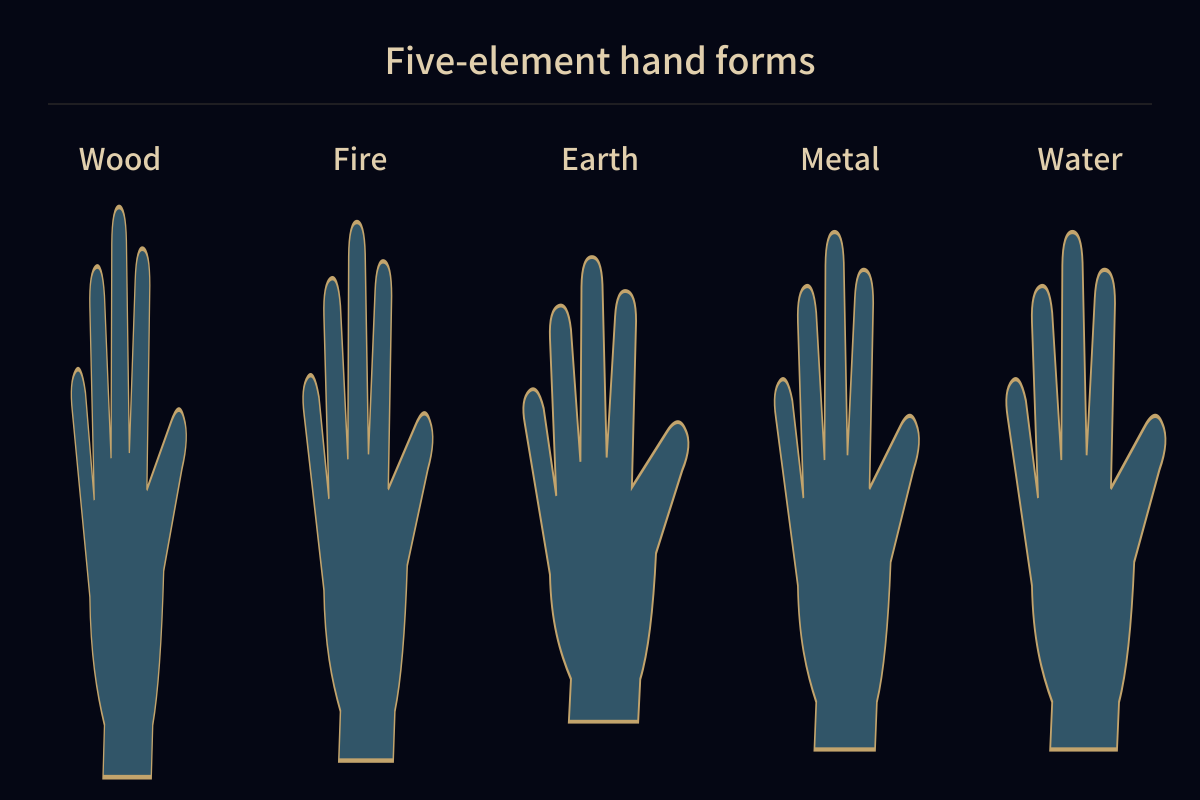
Generated mesh illustrations compare traditional form descriptions. Touch, firmness and skin tone cannot be assessed from these drawings. They are not measurements or judgments of personality or health, and are not conversions of the four Western hand types.
Positions and features
- Wood
- long, with prominent knuckles — a grain that reaches out
- Fire
- pointed fingertips, a reddish tone — a grain that burns
- Earth
- thick and squarish — a grain that stays and accumulates
- Metal
- pale, firm, evenly jointed — a grain that separates and sets
- Water
- soft, yielding flesh — a grain that flows and seeps
At a glance
Eastern palmistry's first step reads the whole hand as Wood, Fire, Earth, Metal or Water — the same thing Western practice sorts, in a different vocabulary.
What is the Five-element palm shapes (五行掌形)?
Before reading any line, Eastern palmistry takes **the shape of the whole hand** and assigns it to one of the five elements. Western practice also sorts hand shapes (into conical, square, spatulate, philosophical), so **the object of study is the same and the sorting vocabulary differs** — except that the East then lays the generating and controlling cycles over it, aiming to read hand shape, lines, and (when a birth chart is present) the given elemental balance within one frame. ⚠️ The finer divisions of the five palm shapes differ between texts, and a hand shape alone does not settle a person. Hands change with a life lived, so convention reads them as the grain of the present.
Frequently asked
- What does the Five-element palm shapes (五行掌形) mean in palmistry?
- Eastern palmistry's first step reads the whole hand as Wood, Fire, Earth, Metal or Water — the same thing Western practice sorts, in a different vocabulary. Before reading any line, Eastern palmistry takes **the shape of the whole hand** and assigns it to one of the five elements. Western practice also sorts hand shapes (into conical, square, spatulate, philosophical), so **the object of study is the same and the sorting vocabulary differs** — except that the East then lays the generating and controlling cycles over it, aiming to read hand shape, lines, and (when a birth chart is present) the given elemental balance within one frame. ⚠️ The finer divisions of the five palm shapes differ between texts, and a hand shape alone does not settle a person. Hands change with a life lived, so convention reads them as the grain of the present.
More in this group
- Is palmistry Eastern or Western?
- The Three-Talent lines (三才紋)
- The eight trigram palaces of the palm (掌中八卦)
- Life Line
- Head Line
- Heart Line
- Fate Line
- Sun Line (Apollo Line)
- Mount of Venus
- Mount of Jupiter
- Mount of Saturn
- Mount of Apollo
- Mount of Mercury
- Mount of Mars
- Mount of the Moon (Luna)
- Palmistry (手相)
- Three major lines (三大線)
- Mounts (丘)
- Which hand to read (左右手)
See how the Five-element palm shapes (五行掌形) reads on your own palm.
Read my palm →Palmistry is a traditional reading of temperament, for reference only — it does not replace medical or legal judgment. Source: 중국 수상학(手相學) 통설 — 삼재문·장중팔괘(掌中八卦).