掌中八卦
The eight trigram palaces of the palm (掌中八卦)
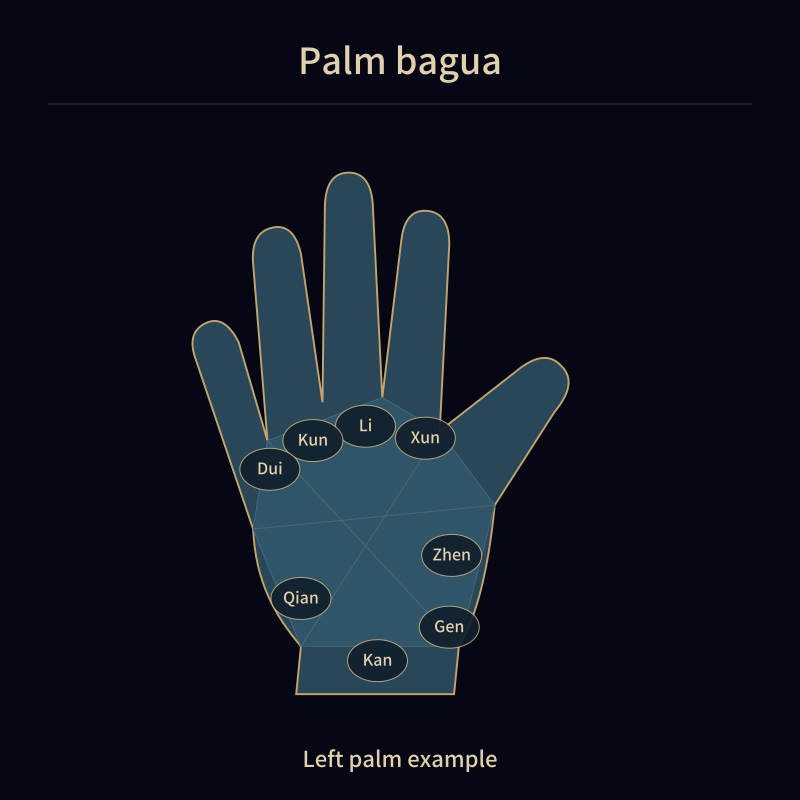
A left palm, with the thumb on the right of the image. Mirror the view for a right palm while retaining the same finger, thumb and wrist landmarks. Markers indicate example region centres, not borders or palm creases. Western mount meanings are not converted into these palaces.
Positions and features
- Qian
- the upper part of the full pad on the little-finger side
- Kan
- the centre just above the wrist
- Gen
- below the thumb ball, toward the wrist
- Zhen
- the middle of the thumb ball itself
- Xun
- under the base of the index finger
- Li
- under the base of the middle finger
- Kun
- under the base of the ring finger
- Dui
- under the base of the little finger
At a glance
Eastern palmistry divides the palm into the eight trigrams — the same ground the West calls mounts, read through a different frame.
What is the The eight trigram palaces of the palm (掌中八卦)?
Eastern palmistry divides the palm into the eight trigram palaces, with the centre called 明堂, the bright hall. Each palace carries one of the five elements and a domain it governs — **Qian** (Metal) father, authority; **Kan** (Water) ancestral ground; **Gen** (Earth) property; **Zhen** (Wood) siblings, nerve; **Xun** (Wood) wealth; **Li** (Fire) office and career; **Kun** (Earth) blessing, mother and children; **Dui** (Metal) the spouse. The bright hall reads a life's rise and fall as a whole. ⚠️ This divides **the same palm** as the Western mounts, on a different frame. Below the little finger the West reads Mercury (communication) and the East reads Dui (the spouse) — same ground, different readings, so mixing the two speaks for neither. ⚠️ Palace borders, and what counts as one being 'developed', differ by lineage. The borders and thresholds MYEONG uses are **MYEONG's adopted values** on the common tradition, and may differ elsewhere.
Frequently asked
- What does the The eight trigram palaces of the palm (掌中八卦) mean in palmistry?
- Eastern palmistry divides the palm into the eight trigrams — the same ground the West calls mounts, read through a different frame. Eastern palmistry divides the palm into the eight trigram palaces, with the centre called 明堂, the bright hall. Each palace carries one of the five elements and a domain it governs — **Qian** (Metal) father, authority; **Kan** (Water) ancestral ground; **Gen** (Earth) property; **Zhen** (Wood) siblings, nerve; **Xun** (Wood) wealth; **Li** (Fire) office and career; **Kun** (Earth) blessing, mother and children; **Dui** (Metal) the spouse. The bright hall reads a life's rise and fall as a whole. ⚠️ This divides **the same palm** as the Western mounts, on a different frame. Below the little finger the West reads Mercury (communication) and the East reads Dui (the spouse) — same ground, different readings, so mixing the two speaks for neither. ⚠️ Palace borders, and what counts as one being 'developed', differ by lineage. The borders and thresholds MYEONG uses are **MYEONG's adopted values** on the common tradition, and may differ elsewhere.
More in this group
- Is palmistry Eastern or Western?
- The Three-Talent lines (三才紋)
- Five-element palm shapes (五行掌形)
- Life Line
- Head Line
- Heart Line
- Fate Line
- Sun Line (Apollo Line)
- Mount of Venus
- Mount of Jupiter
- Mount of Saturn
- Mount of Apollo
- Mount of Mercury
- Mount of Mars
- Mount of the Moon (Luna)
- Palmistry (手相)
- Three major lines (三大線)
- Mounts (丘)
- Which hand to read (左右手)
See how the The eight trigram palaces of the palm (掌中八卦) reads on your own palm.
Read my palm →Palmistry is a traditional reading of temperament, for reference only — it does not replace medical or legal judgment. Source: 중국 수상학(手相學) 통설 — 삼재문·장중팔괘(掌中八卦).