緣 · Compatibility
Chinese Compatibility (Gunghap) — Elements & Zodiac
The deterministic skeleton of East Asian matchmaking: the five-element cycle, zodiac trines and clashes, and the five stem unions.
At a glance
Gunghap (宮合) compares two charts through element cycles, branch combinations, clashes, punishments, harms and wonjin, and day-stem unions. This glossary pairs selected traditional rules with modern metaphors and conversation suggestions. Code calculates the rule signals; the explanations are not presented as the text or direct translation of a particular classic. No signal decides a relationship.
Five-element compatibility — 25 pairings
Read from your own day-master element toward your partner's. Direction matters: giving nourishment differs from receiving it, and controlling differs from being controlled.
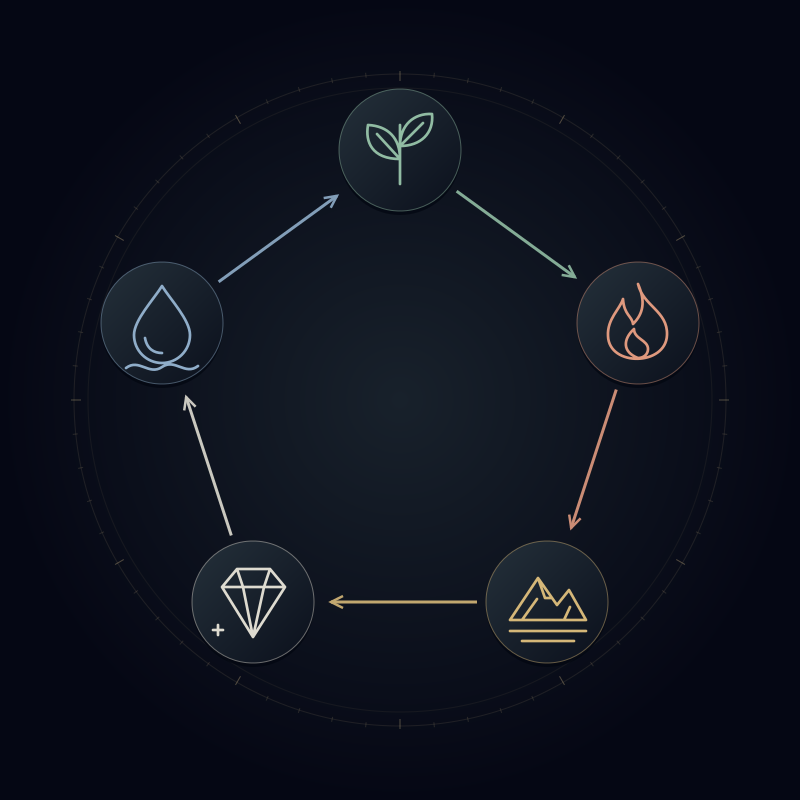
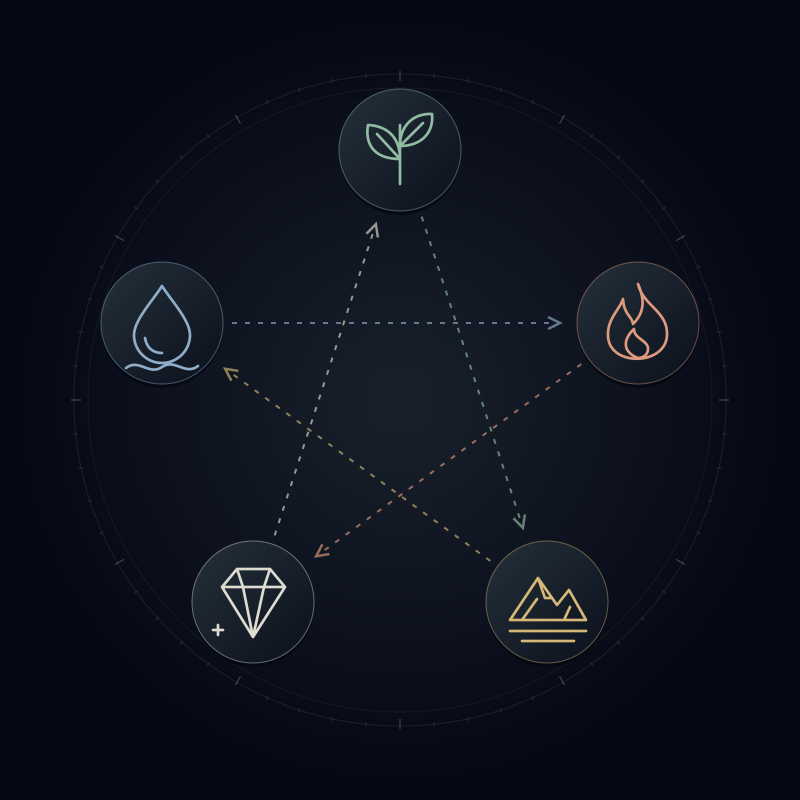
木When you are Wood
木比和Partner is WoodSame element
Two trees alike — easy rapport, shared sunlight
Two Wood people are read here as kindred spirits — similar values, similar pace, conversation that flows. Like two trees sharing one plot, though, growth can turn into rivalry, so a practical approach is to keep room for each to branch out.
木生火Partner is FireGenerating — you nourish them
Wood feeds Fire — you kindle their flame
In the generating cycle Wood feeds Fire: you are read as the one who fuels your partner's passion and shine. It is a giving position — nourishing, but draining if nothing flows back — so a modern suggestion is for the Wood partner to receive as well as give.
木剋土Partner is EarthControlling — you press them
Wood breaks Earth — you take the lead, they yield
Wood controls Earth — roots split the soil as they grow. You tend to steer while your partner absorbs and accommodates. Since your growth rests on their patience, a useful caution is not to exhaust the soil: acknowledge what they quietly carry.
金剋木Partner is MetalControlling — they press you
Metal cuts Wood — their edge shapes you
With Metal controlling Wood, you sit on the receiving end: their principles and sharpness can feel restrictive. Yet as a carpenter's blade turns timber into beams, a modern reading is that with trust this tension becomes discipline that shapes you well.
水生木Partner is WaterGenerating — they nourish you
Water nourishes Wood — you grow in their care
Water feeds Wood: their wisdom and quiet care become the ground you grow from — a metaphor for a supportive pairing. Being the nourished one is comfortable, but this reading invites you to give back so the spring never runs dry.
火When you are Fire
木生火Partner is WoodGenerating — they nourish you
Fire fed by Wood — you burn brighter beside them
As the Fire fed by Wood, their devotion and encouragement make your passion blaze — a pairing where you feel stronger simply being together. The caution: never treat the firewood as given; honor what it costs them to keep you burning.
火比和Partner is FireSame element
Twin flames — instant heat, fast sparks
Two Fire people share instant chemistry — matching passion, matching drive, closeness that comes quickly. But two flames together burn hotter in every direction, feelings included; a practical suggestion is that at least one knows how to cool things down.
火生土Partner is EarthGenerating — you nourish them
Fire warms Earth — your warmth ripens them
Fire generates Earth — flame burns down into fertile ash. Your energy and warmth underwrite their stability and harvest. A useful image is a circle: they solidify through you, and you find rest in their steadiness.
火剋金Partner is MetalControlling — you press them
Fire melts Metal — your heat bends their edges
Fire controls Metal: your emotion and momentum can soften their cool principles. The forge image cuts both ways — the right heat tempers metal into fine tools, too much melts it shapeless — so calibrating your intensity is the crux of this pairing.
水剋火Partner is WaterControlling — they press you
Water checks Fire — their calm can quench or steady you
With Water controlling Fire, their prudence and cool head brake your passion — which can chafe. Yet fire under water is how anything gets cooked: met in the right measure, this tension becomes a working balance. The key is reading their restraint as tuning, not opposition.
土When you are Earth
木剋土Partner is WoodControlling — they press you
Earth held by roots — pressed, yet the one who sustains
As Earth under Wood's roots, their drive and demands can dig into you. Yet no tree stands without soil — their growth ultimately rests on your holding. Tradition's advice: keep accommodating, but mark the line where the digging stops.
火生土Partner is FireGenerating — they nourish you
Earth warmed by Fire — you ripen in their glow
As Earth warmed by Fire, their passion brings heat and life to your steady world — a comfortable, well-matched pairing in this modern reading. The one caution: quiet reliability alone can feel like no answer to a flame; return their warmth out loud now and then.
土比和Partner is EarthSame element
Two hills side by side — solid, slow to change
Two Earth people mirror each other's loyalty and steadiness — few pairings feel as dependable. The flip side is inertia: with both partners slow to move, the relationship can settle into sameness, so a modern suggestion is the occasional shared adventure.
土生金Partner is MetalGenerating — you nourish them
Earth bears Metal — you bring out the ore in them
Earth generates Metal — ore forms inside the ground. Your steady support is what refines their talent and resolve. They find their shine within you; but a mine that is only dug grows hollow, so watch that the giving runs both ways.
土剋水Partner is WaterControlling — you press them
Earth dams Water — you give their current a shape
Earth controls Water as a dam directs a river: your groundedness gives shape to their fluid, changeable nature. A well-built embankment channels water to the fields; a wall makes it flood or find a way around. Guide the current — don't block it.
金When you are Metal
金剋木Partner is WoodControlling — you press them
Metal carves Wood — your standards do the shaping
As the Metal in this pairing, your standards and sharpness shape your partner's direction. The craft metaphor holds the warning: a good carver follows the grain of the wood. Advice that honors their nature helps them grow; cuts against the grain just leave marks.
火剋金Partner is FireControlling — they press you
Metal in the forge — their fire tests and tempers you
As Metal under Fire, their emotional heat puts your principles to the test. Yet no blade is forged cold: the metaphor suggests that a pair who survive each other's temperatures can come out harder-wearing than most.
土生金Partner is EarthGenerating — they nourish you
Metal born of Earth — you shine out of their support
As Metal born of Earth, your talent and resolve are refined inside their quiet, patient support — a modern image of one of the comfortable, durable pairings. Earth's devotion makes no noise, though, and is easy to overlook; be the one who notices first.
金比和Partner is MetalSame element
Blade meets blade — mutual respect, sharp collisions
Two Metal people recognize each other instantly — the same principles, the same decisiveness, real mutual respect. But neither bends easily, and disagreements strike sparks like crossed blades. The pairing works when arguments are fought for understanding, not victory.
金生水Partner is WaterGenerating — you nourish them
Spring from the rock — you set their current flowing
Metal generates Water — a clear spring rising from rock. Your clarity and structure open the channel through which their wisdom and adaptability flow. In this modern reading it is a fine circuit: their thinking clears beside you, and your rigidity softens beside them.
水When you are Water
水生木Partner is WoodGenerating — you nourish them
Water feeds Wood — your care makes them grow
As the Water in this pairing, your wisdom and quiet care push your partner's growth from below. Watching them flourish becomes your own reward — but a spring that only pours runs dry, so a practical suggestion is to keep time that refills you.
水剋火Partner is FireControlling — you press them
Water tempers Fire — you are the cooling hand
As Water over Fire, your prudence settles their intensity. Measured water keeps a flame at working temperature; dumped water kills the ember. A practical approach is to regulate the blaze without ever disrespecting the fire itself.
土剋水Partner is EarthControlling — they press you
Water held by the dam — bounded, but given a place to settle
As Water under Earth's control, their groundedness and rules frame your fluid nature — confining at times. Yet water only deepens where a bank holds it. A modern suggestion is to discuss which boundaries help both people feel supported rather than confined.
金生水Partner is MetalGenerating — they nourish you
Water from the spring — you run clearer at their side
As Water fed by Metal, their clarity and principles channel your thoughts — beside them, your wisdom runs clear. A comfortable pairing in this modern reading; the reciprocal duty is to be the one who loosens their stiffness in return.
水比和Partner is WaterSame element
Two waters merging — deep affinity, drifting course
Two Water people blend like streams meeting — an unspoken understanding of each other's depths, the most miscible of the element pairings. But with both inclined to go where the current takes them, the relationship can drift; a modern suggestion is setting the occasional channel — a shared commitment — to keep a course.
Zodiac trines, seasonal unions & six harmonies
A trine (samhap) joins three branches four positions apart; a seasonal union (banghap) joins three neighboring branches. Six-harmony pairs two. Two of three branches are a partial grouping, not the complete triad.
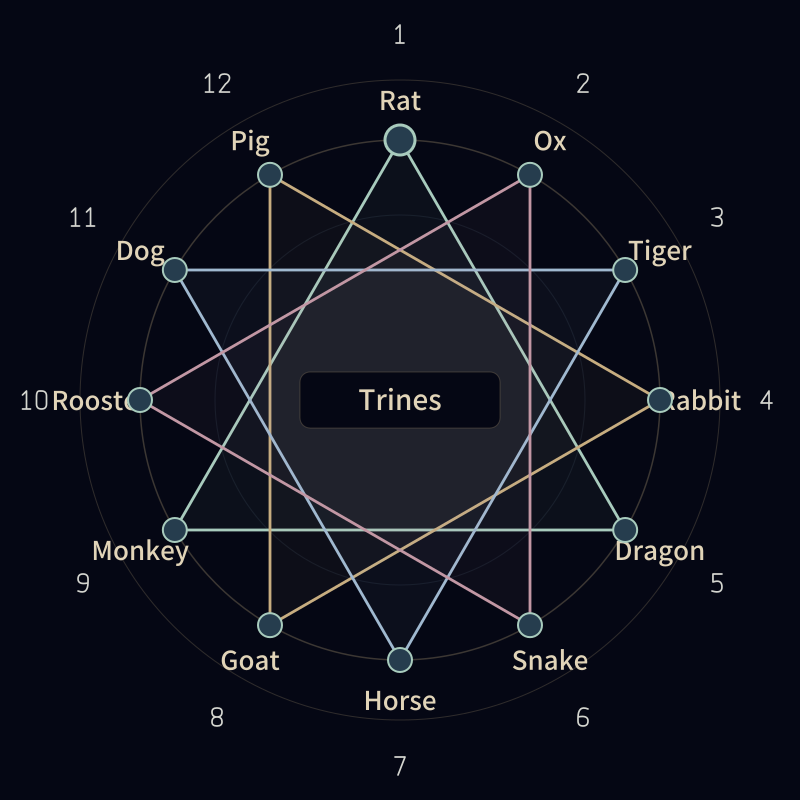
Four branch trines
Clockwise from 1 (子). Numbers match the branches below, not compass directions or a personal compatibility score.
- 1. Rat · 子
- 2. Ox · 丑
- 3. Tiger · 寅
- 4. Rabbit · 卯
- 5. Dragon · 辰
- 6. Snake · 巳
- 7. Horse · 午
- 8. Goat · 未
- 9. Monkey · 申
- 10. Rooster · 酉
- 11. Dog · 戌
- 12. Pig · 亥
申–子–辰 · 亥–卯–未 · 寅–午–戌 · 巳–酉–丑
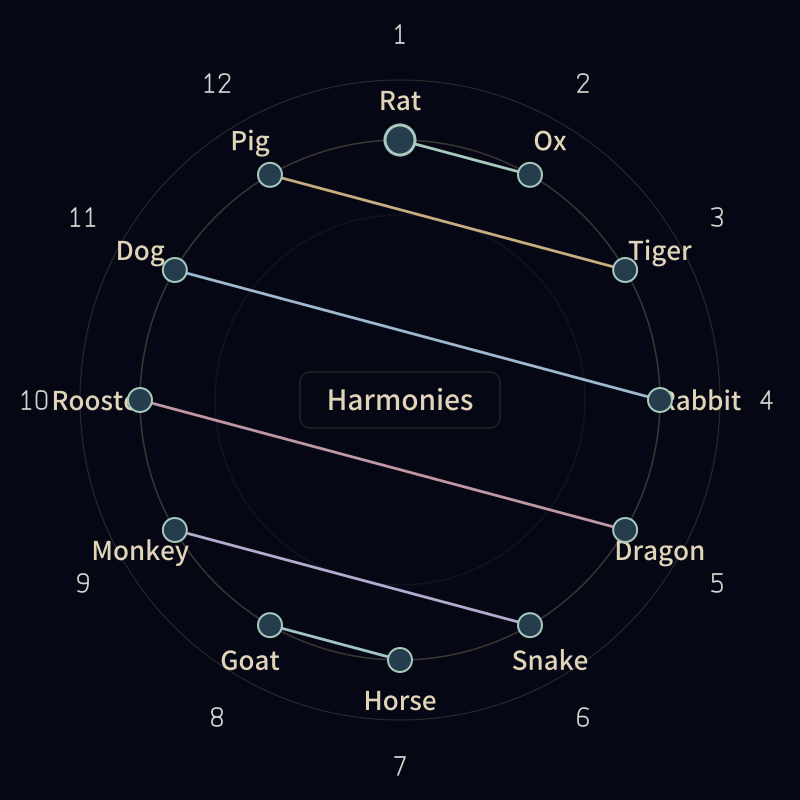
Six branch harmonies
Clockwise from 1 (子). Numbers match the branches below, not compass directions or a personal compatibility score.
- 1. Rat · 子
- 2. Ox · 丑
- 3. Tiger · 寅
- 4. Rabbit · 卯
- 5. Dragon · 辰
- 6. Snake · 巳
- 7. Horse · 午
- 8. Goat · 未
- 9. Monkey · 申
- 10. Rooster · 酉
- 11. Dog · 戌
- 12. Pig · 亥
子–丑 · 寅–亥 · 卯–戌 · 辰–酉 · 巳–申 · 午–未
Enlarge diagram
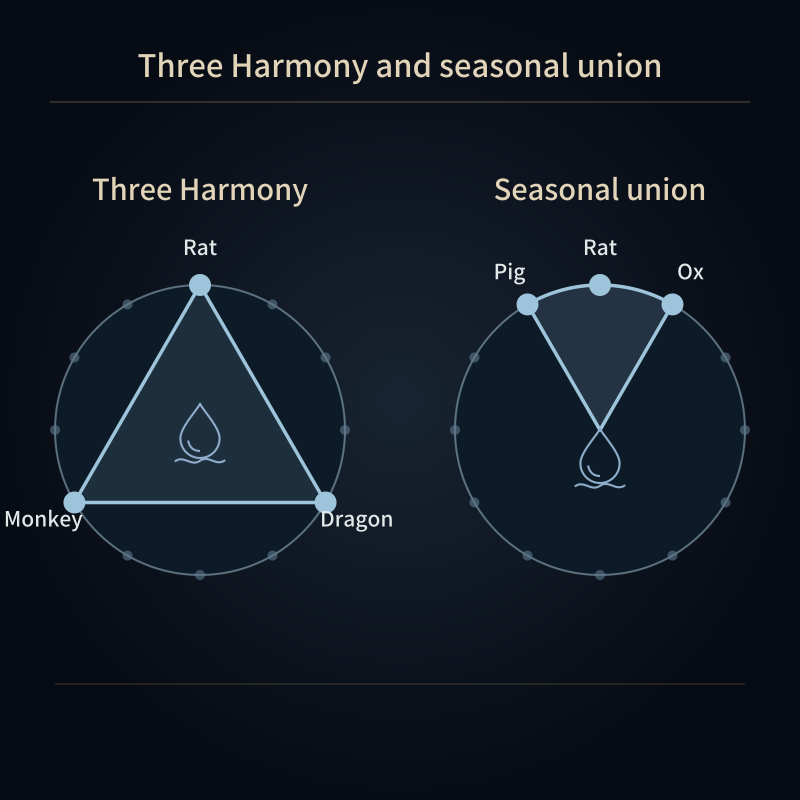
Three Harmony and seasonal union
Water example: Shen–Zi–Chen are four steps apart; Hai–Zi–Chou occupy three consecutive winter positions. A partial pairing is not the complete triad.
Wood · East · spring
Three Harmony: Pig · Rabbit · Goat
Seasonal union: Tiger · Rabbit · Dragon
Fire · South · summer
Three Harmony: Tiger · Horse · Dog
Seasonal union: Snake · Horse · Goat
Metal · West · autumn
Three Harmony: Snake · Rooster · Ox
Seasonal union: Monkey · Rooster · Dog
Water · North · winter
Three Harmony: Monkey · Rat · Dragon
Seasonal union: Pig · Rat · Ox
申子辰Shen–Zi–Chen trine — the Water frame
Monkey · Rat · Dragon
Monkey, Rat and Dragon form the Water trine — one of the four elemental trines of the zodiac. They are read as uniting through wit and adaptability; even two of the three together (a half-trine) is considered an easy, well-oiled bond.
亥卯未Hai–Mao–Wei trine — the Wood frame
Pig · Rabbit · Goat
Pig, Rabbit and Goat form the Wood trine. Traditionally the gentlest of the four frames — a trio that connects through warmth and consideration, each quietly encouraging the others' growth.
寅午戌Yin–Wu–Xu trine — the Fire frame
Tiger · Horse · Dog
Tiger, Horse and Dog form the Fire trine — a trio bound by passion and loyalty. Together their momentum multiplies; this modern reading presents this as the most action-oriented of the four frames.
巳酉丑Si–You–Chou trine — the Metal frame
Snake · Rooster · Ox
Snake, Rooster and Ox form the Metal trine — a trio that connects through precision and diligence. Tradition reads them as steady collaborators: a practical bond built for long journeys toward a shared goal.
子丑Zi–Chou harmony — Rat & Ox
Rat · Ox
Rat and Ox are the first of the six harmony pairs, traditionally said to unite into Earth. The Rat's quickness and the Ox's steadfastness cover each other's blind spots — a match where trust deepens slowly and surely.
寅亥Yin–Hai harmony — Tiger & Pig
Tiger · Pig
Tiger and Pig are read as uniting into Wood. The bold, forward-charging Tiger is generously received by the easygoing Pig — drive and ease balancing into a pair that simply relaxes around each other.
卯戌Mao–Xu harmony — Rabbit & Dog
Rabbit · Dog
Rabbit and Dog are said to unite into Fire. The sensitive Rabbit and the loyal Dog form a mutually protective bond — a modern image of one of the warmest, most reassuring of the six pairs.
辰酉Chen–You harmony — Dragon & Rooster
Dragon · Rooster
Dragon and Rooster are read as uniting into Metal. The Dragon sketches the grand design and the Rooster perfects the details — vision and execution interlocking into a productive match.
巳申Si–Shen harmony — Snake & Monkey
Snake · Monkey
Snake and Monkey are said to unite into Water — two quick minds that connect through strategy. Uniquely, this pair is both a harmony and a punishment (xing) in the selected rules; a modern suggestion is: the closer you get, the more courtesy matters.
午未Wu–Wei harmony — Horse & Goat
Horse · Goat
Horse and Goat are known as the harmony of Sun and Moon. The lively Horse and the gentle Goat complement each other like day and night — a pair that falls into balance almost without trying.
Clashes, punishments, harms & wonjin — the tensions
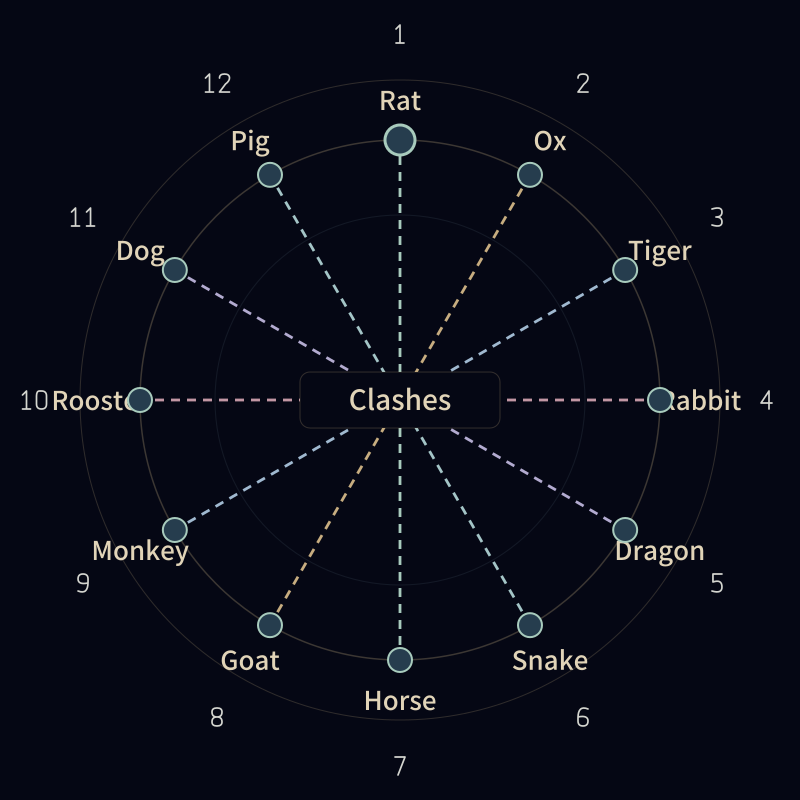
A clash (chung) is a head-on opposition across the wheel; punishment, harm and wonjin are subtler frictions. All are read as tuning points, not sentences.
Enlarge diagram
Six branch clashes
Clockwise from 1 (子). Numbers match the branches below, not compass directions or a personal compatibility score.
- 1. Rat · 子
- 2. Ox · 丑
- 3. Tiger · 寅
- 4. Rabbit · 卯
- 5. Dragon · 辰
- 6. Snake · 巳
- 7. Horse · 午
- 8. Goat · 未
- 9. Monkey · 申
- 10. Rooster · 酉
- 11. Dog · 戌
- 12. Pig · 亥
子–午 · 丑–未 · 寅–申 · 卯–酉 · 辰–戌 · 巳–亥
子午Zi–Wu clash — Rat vs Horse
Rat · Horse
Rat and Horse sit directly opposite on the wheel — Water meeting Fire head-on, the starkest temperature gap of the six clashes. But a clash is a jolt, not a verdict: acknowledged well, the difference can keep both partners awake and growing.
丑未Chou–Wei clash — Ox vs Goat
Ox · Goat
Ox and Goat are an Earth-against-Earth clash — quiet on the surface, but stubbornness meeting stubbornness underneath. Since neither backs down by nature, one practical approach is deliberate practice at yielding first.
寅申Yin–Shen clash — Tiger vs Monkey
Tiger · Monkey
Tiger and Monkey clash as the straight line against the zigzag — each easily reads the other as either rigid or flippant. Both are travel-star branches, though, so the metaphor offers a twist: on the move, working side by side, the friction can turn into spark.
卯酉Mao–You clash — Rabbit vs Rooster
Rabbit · Rooster
Rabbit and Rooster clash as softness against sharpness — a pair where wounds tend to come from how things are said rather than what is meant. A conversation suggestion: choose the wrapping words before the correcting ones.
辰戌Chen–Xu clash — Dragon vs Dog
Dragon · Dog
Dragon and Dog clash as vision against realism — two strong convictions that easily turn into a battle of directions. Yet the same force cuts the other way: the moment their goals align, that doubled conviction can move something big.
巳亥Si–Hai clash — Snake vs Pig
Snake · Pig
Snake and Pig clash as meticulousness against easygoingness — one partner frets, the other feels micromanaged. Give each other half a beat, in this reading, and the Snake's depth and the Pig's generosity start healing exactly what the other lacks.
刑Xing (punishment) — grinding friction
寅巳申 · 丑戌未 · 子卯 · 辰辰/午午/酉酉/亥亥(自刑)
Xing comes in three chains — Yin–Si–Shen, Chou–Xu–Wei, Zi–Mao — plus the self-punishments of Chen, Wu, You and Hai meeting themselves. Unlike a head-on clash it is a slow abrasive friction; this reading uses it as a signal that closeness needs courtesy and a little distance to stay healthy.
害Hai (harm) — six quiet underminers
子未 · 丑午 · 寅巳 · 卯辰 · 申亥 · 酉戌
The six harms — Zi–Wei, Chou–Wu, Yin–Si, Mao–Chen, Shen–Hai, You–Xu — arise where one branch clashes the other's harmony partner, a quiet undermining rather than open conflict. Nothing dramatic shows on the surface, but small resentments stack; this reading suggests clearing minor misunderstandings as they come.
怨嗔Wonjin — the inexplicable push-and-pull
子未 · 丑午 · 寅酉 · 卯申 · 辰亥 · 巳戌
Wonjin (yuanchen) names six pairs — Zi–Wei, Chou–Wu, Yin–You, Mao–Shen, Chen–Hai, Si–Xu — bound by an unexplained push-and-pull of irritation and attraction. It is one of the signals Korean matchmaking watches most closely; a modern reading is that naming out loud what grates on each other converts the turbulence into unusually deep affection.
The five stem unions (ganhap)
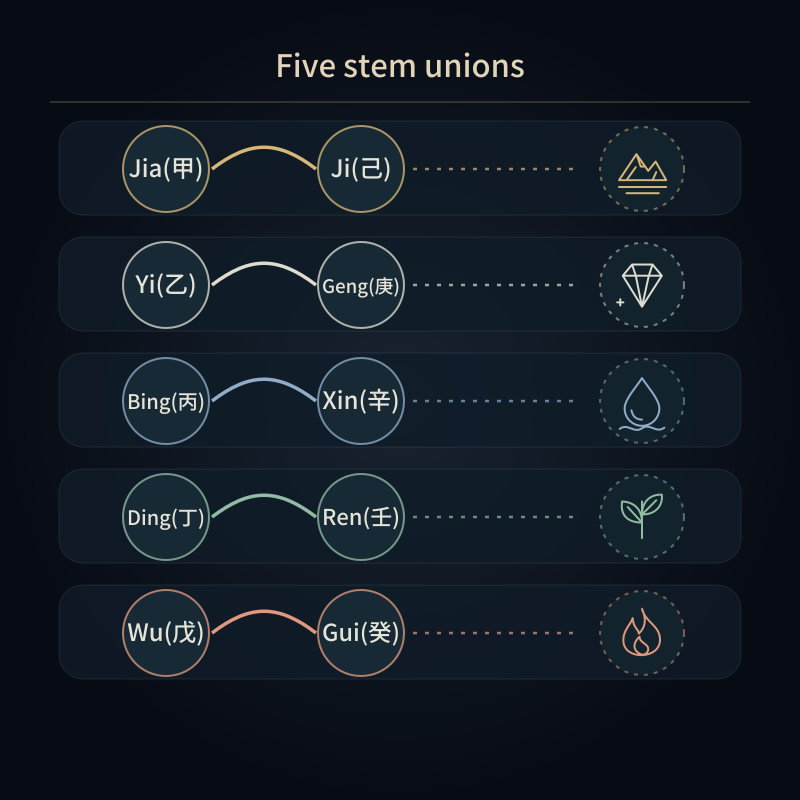
The ten heavenly stems pair off into five unions. A paired day stem is traditionally read as attraction; actual transformation into the named element depends on the season and the rest of the chart.
Enlarge diagram
Five stem unions
The pairs form five unions. The element at right is a possible transformation, not a guaranteed outcome.
- Jia(甲) + Ji(己) → Earth
- Yi(乙) + Geng(庚) → Metal
- Bing(丙) + Xin(辛) → Water
- Ding(丁) + Ren(壬) → Wood
- Wu(戊) + Gui(癸) → Fire
甲己合土Jia–Ji — the upright union
Jia Wood and Ji Earth combine into Earth — classically the "union of uprightness." Like a great tree rooted in fertile farmland, ambition meets stability in a modern metaphor for a dependable bond.
乙庚合金Yi–Geng — the union of kindness and duty
Yi Wood and Geng Metal combine into Metal — the "union of kindness and duty," where suppleness meets steel. Like a vine climbing solid rock, their very difference becomes what each leans on.
丙辛合水Bing–Xin — expression meets discernment
Bing Fire and Xin Metal are classified as a Water union. The sun and jewel are modern metaphors for differences in expression and discernment. Use the image to discuss which words feel encouraging, so the wish to bring out each other's strengths need not turn into judgment or competition.
丁壬合木Ding–Ren — warmth meets depth
Ding Fire and Ren Water are classified as a Wood union. Lamplight and a river are MYEONG's modern metaphors for differences within a relationship. Use them to discuss how each person expresses warmth and what emotional depth they hope for; the image does not predict how long a relationship will last.
戊癸合火Wu–Gui — the union of contrasts
Wu Earth and Gui Water combine into Fire — the great mountain meeting fine rain, traditionally dubbed the "union without sentiment" for its stark contrast. Modern readings soften the old name: worlds this different have much to teach each other, if the gap is taken as freshness rather than coldness.
Curious how your two full charts — BaZi, Zi Wei and names — read together?
Read our compatibilityCompatibility readings summarize a classical perspective for reference; they are not a judgment on any relationship. Real decisions belong to the two people talking.
Want the full reading — two charts, ziwei and names layered together?
Read our compatibility →