命 · Calculation Standards
Calculation Standards — the exact rules behind every chart
Apparent solar time · historical KST offsets · the night-子 day boundary · Zi Wei 四化 variants · Tuần·Triệt · the daily Nine Star cycle switch — every rule we compute by, in the open.
At a glance
Every chart MYEONG computes is deterministic — the same birth data always yields the same four pillars and the same Zi Wei chart, and AI touches only the written interpretation. This page discloses every standard that computation follows: the true-solar-time correction, the night-子 day boundary, the 四化 table, the void overlays, and the daily Nine Star cycle switch. And where the standard itself differs between schools — true solar time, the 子時 policy, the 四化 variant, Tuần·Triệt — you can choose your own basis in your profile's Calculation basis settings.
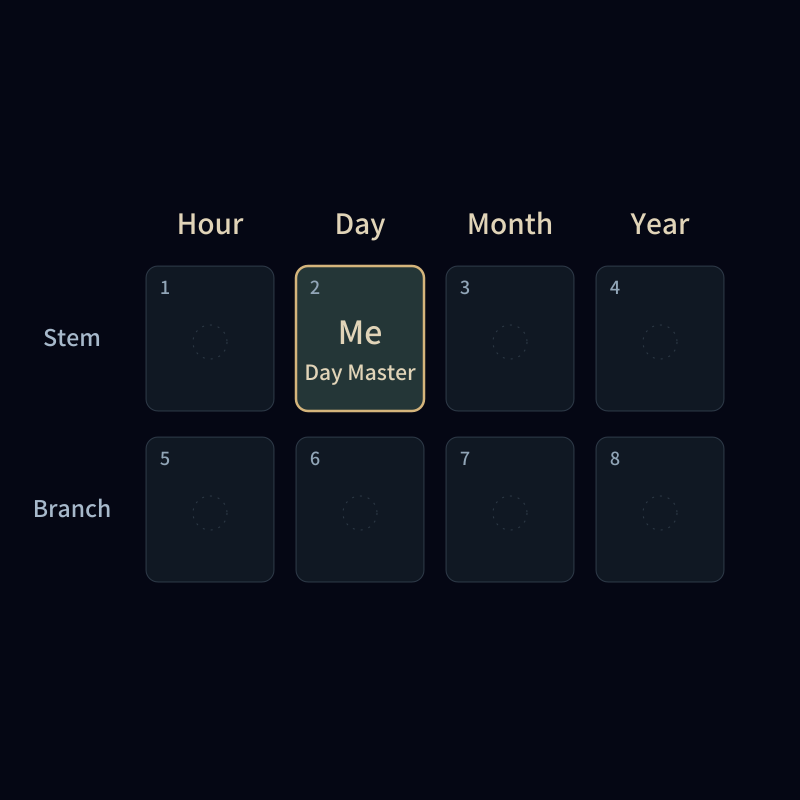
Enlarge diagram
Empty Four Pillars chart — hour, day, month, year
Left to right: hour, day, month, year — the same order as the live chart. Top row stems, bottom row branches. The thick cell is the Day Master. No one's chart is written in.
- 1. Hour stem
- 2. Day stem · Day Master
- 3. Month stem
- 4. Year stem
- 5. Hour branch
- 6. Day branch
- 7. Month branch
- 8. Year branch
層Layers — dangsaju (the way in) and saju/zi wei measure different things
Fixed standard (no option)
Dangsaju starts from the zodiac branch of the birth year, adds the lunar month, day and hour to turn a wheel, and assigns twelve heavenly stars to four seats — early life, midlife, late life and lifetime. Since it takes only a birth date, it can be seen with no account and no fee; in exchange it never reaches the layer where an hour pillar is raised and the strength of the five elements, the direction of the ten gods and the useful god are weighed. MYEONG keeps this branch as an easy way into the service, and does not present it as a full reading.
This is why star compatibility (dangsaju) and the full compatibility reading (saju, natal trigram, zi wei, name) can score the same couple differently. Neither is wrong; the axes differ. Star compatibility reads the relation two life stars form on the wheel — 三合, 六合, 沖 and distance — while the full reading measures and weights several separate axes such as the day stem, the day branch, the useful god and the natal trigram. When the two diverge, look first at what is being measured rather than doubting the input.
One overlap is worth naming. Both branches touch the year branch — the zodiac sign, in everyday speech — but they use it differently. Dangsaju takes it as a starting seed and adds month, day and hour to turn a wheel, so two people born in the same zodiac year still land on different stars. The full compatibility reading instead reads the year branch's combinations and clashes as one of four pillars, and weights it below the day branch: +6 versus +8 for a triad, −4 versus −12 for a clash. That is why it is not zodiac-only matching.
時Almanac & time correction — apparent solar time and the dual clock
Adjustable in profile → Calculation basis
The clock time on a birth certificate is administrative standard time, not the sun's actual position. MYEONG corrects it by birth longitude — 4 minutes per degree from the standard meridian — plus the equation of time (NOAA approximation, ~1-second accuracy, ranging roughly −14 to +16 minutes over the year) to obtain apparent solar time. Seoul (126.978°E), for instance, sits west of the 135°E meridian, so its solar time runs about 32 minutes behind the clock — the single most common reason two calculators disagree on the hour pillar.
The history of the timezone itself is honored too. Korean standard time used UTC+8:30 (meridian 127.5°E) in 1908–1911 and again from 1954-03-21 to 1961-08-09, and observed daylight saving in 1948–51, 55–57, 59–60, and 87–88. MYEONG handles this automatically via the IANA timezone database (Asia/Seoul), switching the standard meridian between 127.5° and 135° to match the era — the second reason charts for those birth years differ between sites.
Two clocks are used together (a dual clock). The year/month boundaries — 立春 and the monthly term entries — are single planet-wide instants when the sun reaches a fixed ecliptic longitude, independent of where you were born, so they are judged in standard time (a longitude-shifted clock would misplace births within ~32 minutes of a term). The day pillar's 子時 boundary and the hour pillar, however, are local-solar concepts, so they are judged in apparent solar time. The true-solar correction itself can be turned off in your profile — that reproduces the 'clock time as written' school.
| Period | Offset | Meridian |
|---|---|---|
| 1908.4.1 – 1911.12.31 | UTC+8:30 | 127.5°E |
| 1912.1.1 – 1954.3.20 | UTC+9 | 135°E |
| 1954.3.21 – 1961.8.9 | UTC+8:30 | 127.5°E |
| 1961.8.10 – | UTC+9 | 135°E |
Daylight-saving years: 1948–51 · 1955–57 · 1959–60 · 1987–88 (applied automatically via IANA Asia/Seoul data).
子Night-子時 — which day owns a birth after 11 pm
Adjustable in profile → Calculation basis
子時 spans 23:00–00:59 in apparent solar time. The catch: its first half (the 23:00 hour) falls on the previous calendar day — and schools disagree on which day owns that birth's day pillar. MYEONG offers both policies as exact rules. (1) Split (the default): a birth at 23:00–23:59 apparent solar time advances the day pillar to the next day — the traditional Korean night-子時 reading, 'the day turns when 子時 opens.' (2) Unified: the day pillar stays on the apparent-solar calendar date; the day turns only at midnight — the common modern reading.
This choice changes the four pillars only for births in the apparent-solar 23:00 hour — every other birth time is identical either way. In your profile's Calculation basis you can preview whether your own pillars actually diverge before saving.
化Zi Wei 四化 variants — MYEONG standard vs the common 三合 table
Adjustable in profile → Calculation basis
The Four Transformations (化祿·化權·化科·化忌) are fixed by the birth-year stem — 10 stems × 4 = 40 entries, and MYEONG's standard table is fully populated including the auxiliary stars (文昌·文曲·左輔·右弼). Of those 40 entries, only two cells have variants that are solidly attested across schools — the 化科 of a 戊 year and the 化科 of a 壬 year — diverging as the table below shows. A variant does not replace the whole table: the other 38 entries are identical either way.
The 庚 stem also has debated variants (化科 as 太陰 vs 天府, among others), but the evidence is not settled, so MYEONG does not offer it as an option — we never fill a table by guesswork. Switching the variant changes the natal 四化 only for people born in a 戊 or 壬 year; every other birth-year stem is identical either way.
| Year stem | Cell | MYEONG standard | 三合 (common) |
|---|---|---|---|
| 戊 | 化科 | 太陽 | 右弼 |
| 壬 | 化科 | 左輔 | 天府 |
空Tuần·Triệt (旬空·截路) — the Vietnamese Tử Vi void overlays
Adjustable in profile → Calculation basis
The Vietnamese Tử Vi tradition lays two blocking (án ngữ) markers over the chart. Both are pure lookups determined by the birth year pillar alone. Tuần Không (旬中空亡): the 60 stem-branch pairs split into six decades (旬) of ten; each decade leaves two of the twelve branches unpaired, and those two are its voids — Tuần marks the two palaces void in the decade your year pillar belongs to. Triệt Lộ (截路空亡): determined by the year stem alone — running the 五鼠遁 hour-stem cycle, the two branches whose stems come out 壬·癸 (water) are the voids, 'water cutting the road,' and Triệt marks those two palaces.
This overlay is off by default — it is a layer specific to the Vietnamese tradition, not normally used in Chinese or Korean Zi Wei practice. Turning it on changes nothing about the four pillars, star placements, or 四化: it only adds a display layer to the Zi Wei chart (no interpretive weighting), and your saju and 命書 are unaffected.
| Decade (旬) | Range | Void branches |
|---|---|---|
| 甲子旬 | 甲子–癸酉 | 戌·亥 |
| 甲戌旬 | 甲戌–癸未 | 申·酉 |
| 甲申旬 | 甲申–癸巳 | 午·未 |
| 甲午旬 | 甲午–癸卯 | 辰·巳 |
| 甲辰旬 | 甲辰–癸丑 | 寅·卯 |
| 甲寅旬 | 甲寅–癸亥 | 子·丑 |
| Year stem | Triệt branches |
|---|---|
| 甲·己 | 申·酉 |
| 乙·庚 | 午·未 |
| 丙·辛 | 辰·巳 |
| 丁·壬 | 寅·卯 |
| 戊·癸 | 子·丑 |
遁Daily Nine Star (日家九星) cycle switch — why today carries this star
Fixed standard (no option)
The 'star of the day' in Nine Star Ki alternates between two phases. Yang cycle (陽遁): begins around the winter solstice — the anchor 甲子 day carries One White, then the stars advance one per day (1→2→…→9→1). Yin cycle (陰遁): begins around the summer solstice — the anchor 甲子 day carries Nine Purple, then the stars retreat (9→8→…→1→9). MYEONG's switch rule: the cycle flips on the 甲子 day nearest the solstice, and when the solstice sits exactly 30 days from the 甲子 days on both sides, the later 甲子 day is used.
Honest disclosure: cycle-switch handling — especially the intercalation (置閏) adjustment — differs between schools and almanacs. MYEONG uses only the 'nearest 甲子 day' convention above and invents no additional correction, so near a switch (most visibly in years where the switch 甲子 slides into January) our daily star can differ from other almanacs by days to weeks. This standard is fixed for the consistency of the daily direction content — it is not a user option.
音Sound-element assignment — prevailing usage vs the Hunminjeongeum original
Fixed standard (no option)
The sound-element reading of a Korean name (발음오행 / 음령오행) assigns each initial consonant to one of the five elements to trace the flow of energy across the name — for a pure-Hangul name with no hanja, it is the only deterministic signal. MYEONG uses the assignment prevailing in Korean naming practice: molar 牙 ㄱ·ㅋ = 木, lingual 舌 ㄴ·ㄷ·ㄹ·ㅌ = 火, dental 齒 ㅅ·ㅈ·ㅊ = 金, and the two groups schools dispute — guttural 喉 ㅇ·ㅎ = 土, labial 脣 ㅁ·ㅂ·ㅍ = 水. This is the standard shared across Korean naming services today, so our assignment does not conflict with other naming studios or apps.
Honest disclosure: these two groups are exactly the reverse of the original assignment in the 訓民正音 解例本 (Hunminjeongeum Haerye, 1446), whose 制字解 reads the guttural as 水 (“the throat is deep and moist — water”) and the labial as 土 (“the lips are square and closed — earth”). The prevailing assignment (guttural 土, labial 水) took hold while the Haerye was lost for centuries — rediscovered only in 1940 — and was fixed by later phonological works such as Sin Gyeong-jun’s 訓民正音韻解 (1750): not a baseless error but an established lineage of late-Joseon and modern naming. MYEONG follows the prevailing standard rather than the original because that is what today’s naming market uses, so a user cross-checking elsewhere finds the same assignment. Only the labial and guttural groups differ; the other three (ㄱㅋ 木, ㄴㄷㄹㅌ 火, ㅅㅈㅊ 金) are identical in every school. This standard is fixed for assignment consistency — it is not a user option.
Frequently asked questions
- Why do different sites give me different charts?
- Mostly it's a difference of standards. (1) Whether true-solar-time correction is applied (about −32 minutes for Seoul — the most common cause of differing hour pillars); (2) the night-子時 policy (which day owns a 23:00-hour birth); (3) which clock judges the solar-term boundaries (standard vs corrected time — splitting year/month pillars for births near a term); (4) whether historical KST offsets (UTC+8:30, DST) are honored. MYEONG discloses all of these and lets you choose (1) and (2) yourself.
- Why these defaults?
- True solar 'on' and night-子時 'split' are the prevailing standards of traditional Korean practice, so they are the defaults — follow the sun rather than the clock, and let the day turn when 子時 opens. For the 四化 we default to the fully-populated MYEONG standard (戊→科太陽, 壬→科左輔) and offer the common 三合 variant as an option. Tuần·Triệt is a layer specific to the Vietnamese tradition, so it defaults to off — turn it on if it's yours. Which choice is 'more accurate' is a question of school, not of evidence, so the defaults are recommendations, never mandates.
- What happens to reports I've already paid for if I change a standard?
- Your saju and Zi Wei chart are recomputed automatically on the new basis the next time you view them. An already-issued 命書 report is marked as computed on the previous basis, and re-weaving it on the new basis is done via the refresh action on the 命書 screen (cost shown there) — it is not regenerated automatically or for free. The one exception: changing only Tuần·Triệt leaves the four pillars untouched, so only the Zi Wei chart's display layer updates.
- Why can I only choose calculation standards, not an interpretive school?
- Because they live on different layers. Calculation standards — true solar time, the 子時 policy, the 四化 and void tables — are matters of explicit, codified values: they can be published as tables, verified, and offered as user choices. An interpretive school (三合, 飛星, 中州 — which lens reads the chart) is a matter of perspective on the same chart, and cannot be pinned to a single value. So MYEONG treats only the computation layer as a configurable standard, describes the school landscape neutrally in dedicated guide pages, and keeps interpretation explicitly separated in the AI layer.
See which standards your own chart was built on — and adjust them yourself.
This page documents the actual rules of MYEONG's calculation engine, as implemented. The interpretive systems themselves are traditional frameworks, not empirical science; readings are for reference.
Curious how these read in your own chart?
Read my chart →