Different centre, different positions
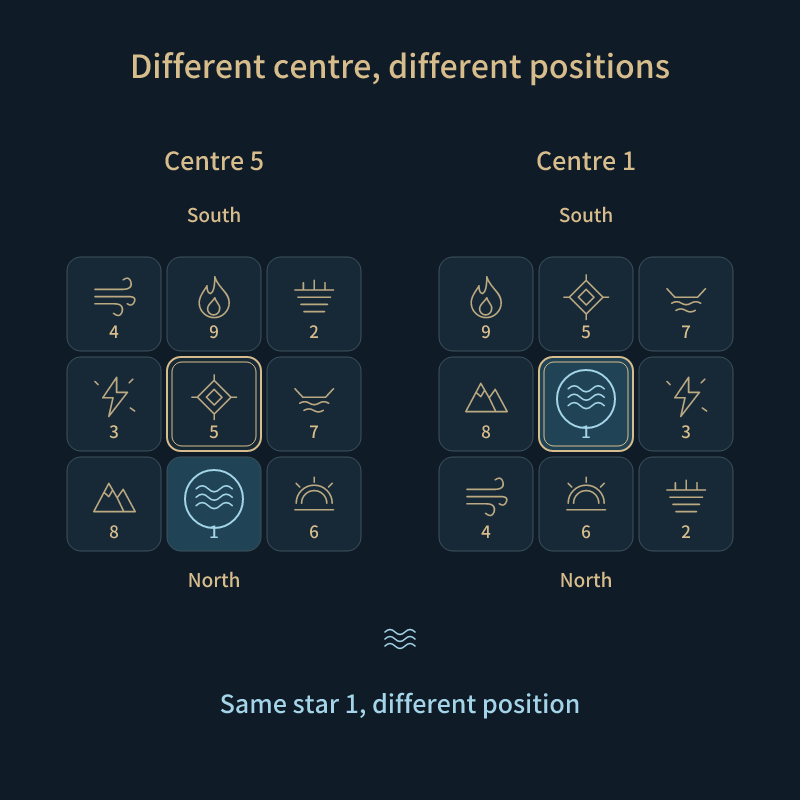
Compare two examples to see how the centre star determines all nine positions.
Enlarge diagram
Both boards place south at the top. Star 1 sits in the north cell on the left and the centre on the right. Double borders mark the centre; circles and the water symbol identify the same star 1.
The emblems identify stars using their home trigrams; they do not denote the current cell’s direction or the star’s five-element identity. The diamond identifies star 5; the actual centre is the double-bordered cell.
These are two layout examples, not consecutive dates or a physical travel path. They do not show today’s directions or personal auspices. The centre is a cell, not a compass direction.
Read about the centre and Luoshu
Centre palace (中宮)
The centre palace is the middle of the nine-cell board. It is a centre rather than a direction, so 'heading toward the centre palace' is not a meaningful move; instead, the star sitting here determines the whole arrangement of the other eight cells. That is why the first question when reading a year, month or day is which star holds the centre. One case matters especially in practice: when Five Yellow Earth occupies the centre, neither the Five Yellow curse nor the hidden-sword curse forms for that period, because the seat of the curse is locked in the middle. Two unfavorable directions drop out, which makes such periods noticeably freer for choosing a direction to move or travel.
Luoshu nine palaces (洛書九宮)
The Luoshu arranges the numbers 1 to 9 in a three-by-three square so that every row, column and diagonal adds to fifteen. Nine Star Ki uses that arrangement as the frame of its directional board, and the nine stars travel from cell to cell in fixed order to produce each year's, month's and day's layout. Every star also has a home seat on the Luoshu — One White Water in the north, Nine Purple Fire in the south, and so on — and returning to that seat is sometimes read on its own. The board is conventionally drawn with south at the top, so it appears upside down compared with a map.
Source: reviewed Nine Star Ki glossary and MYEONG engine layout tables.