Date selection
Date Selection Glossary 擇日
Yellow & Black Way · the Twelve Officers · son-free days · Three Calamities
In short
Date selection (擇日) is the art of choosing a day suited to a beginning that matters — a wedding, a move, an opening. For each candidate day the day's stem-and-branch is set from the perpetual calendar, then read against the calendar's own rotations (the twelve Yellow-and-Black Way spirits and the twelve Jianchu officers), the seasonal notions of son-free days and the three-calamity years, and the unions, clashes, punishments and harms between that day and your own chart. All of it is deterministic — the same inputs give the same answer for anyone — and only the weighting shifts with purpose. Choosing a good day is less about avoiding a bad one than about matching the grain of the day to the grain of what you are about to do.
Foundations
擇日Date selection
The art of choosing a day suited to a beginning that matters — a wedding, a move, an opening.
Date selection (擇日) asks 'when'. For each candidate day the day's stem-and-branch is set from the perpetual calendar, then read against the calendar's own rotations — the twelve Yellow-and-Black Way spirits and the twelve Jianchu officers — the seasonal notions of son-free days and the three-calamity years, and finally the unions, clashes, punishments and harms between that day and the person's own chart. All of this is computation: the same inputs give the same answer for anyone. What shifts is the weighting, because the purpose changes it. A wedding leans hard on unions and noble stars and refuses clashes; a move favours the travelling-horse and the Yellow Way; an opening weighs the day that supplies the chart's needed element and the officers that 'complete' and 'open'. Choosing a good day is less about avoiding a bad one than about matching the grain of the day to the grain of what you are about to do.
日辰Day pillar
The stem-and-branch assigned to a single day — the basic unit everything in date selection reads.
The day pillar is one of the sexagenary sixty, assigned a day at a time. Jiazi through Guihai run in order and come round every sixty days, and this rotation is a property of the calendar itself, independent of any person — anyone computing it at any time gets the same result. Nearly every judgement in date selection comes from it: the Yellow-and-Black Way spirits and the Jianchu officers are fixed by comparing the month branch with the day branch, and unions, clashes, punishments and harms by comparing that day's pillars with those of your own chart. Today's day pillar can be checked on the almanac page without an account.
Yellow and Black Way
Enlarge diagram
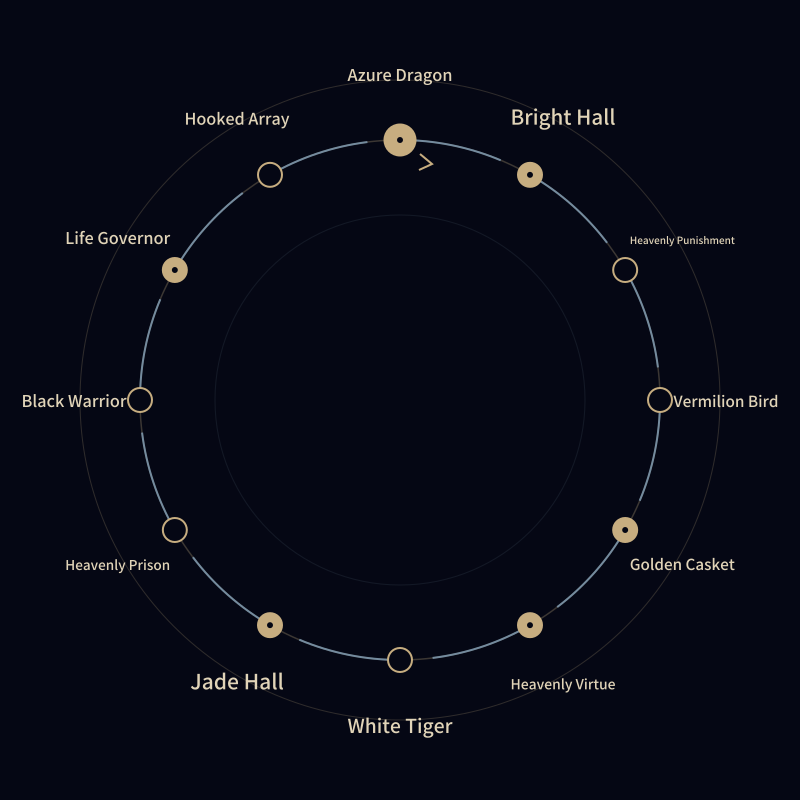
Twelve daily gods
Read clockwise from 1 at the top. This shows sequence, not a date forecast; the starting day branch depends on the month branch.
● Yellow Way · ○ Black Way — traditional categories
- 1. Azure Dragon
- 2. Bright Hall
- 3. Heavenly Punishment
- 4. Vermilion Bird
- 5. Golden Casket
- 6. Heavenly Virtue
- 7. White Tiger
- 8. Jade Hall
- 9. Heavenly Prison
- 10. Black Warrior
- 11. Life Governor
- 12. Hooked Array
黃道日Yellow Way dayAuspicious
A day held by one of the six benign spirits — broadly sound for a large occasion.
The Yellow-and-Black Way is a rotation in which twelve spirits take a day each in turn. The starting seat is fixed by the month branch, and six — Azure Dragon (靑龍), Bright Hall (明堂), Golden Casket (金匱), Heavenly Virtue (天德), Jade Hall (玉堂) and Life Governor (司命) — count as Yellow Way, while Heavenly Punishment (天刑), Vermilion Bird (朱雀), White Tiger (白虎), Heavenly Prison (天牢), Dark Warrior (玄武) and Hooked Chen (勾陳) count as Black Way. A Yellow Way day is read as one whose grain runs smooth, broadly sound for weddings, openings and moves — occasions that gather people. Since six of twelve qualify, roughly every other day is one, so being Yellow Way alone does not settle a date: it is read together with the Jianchu officer and with the unions and clashes against your own chart.
- Suited to
- Wedding · Opening · Moving · Contracts
黑道日Black Way dayInauspicious
A day held by one of the six harsh spirits — better to move a large occasion off it.
A Black Way day is one held by Heavenly Punishment, Vermilion Bird, White Tiger, Heavenly Prison, Dark Warrior or Hooked Chen among the twelve. Its grain is read as clouded, so occasions that are hard to undo — weddings, openings — have traditionally been moved off it. That does not make it a day on which nothing may be done: six of twelve qualify, so half the year is Black Way, and for ordinary work or for tidying and finishing rather than starting, it was not much minded. When a large occasion cannot avoid one, the practice is to pick a day where the Jianchu officer 'completes' (成) or 'opens' (開), or where a union or a noble star of your own falls, and let those offset the weight.
- Avoid
- Wedding · Opening · Moving
The Twelve Officers
Enlarge diagram
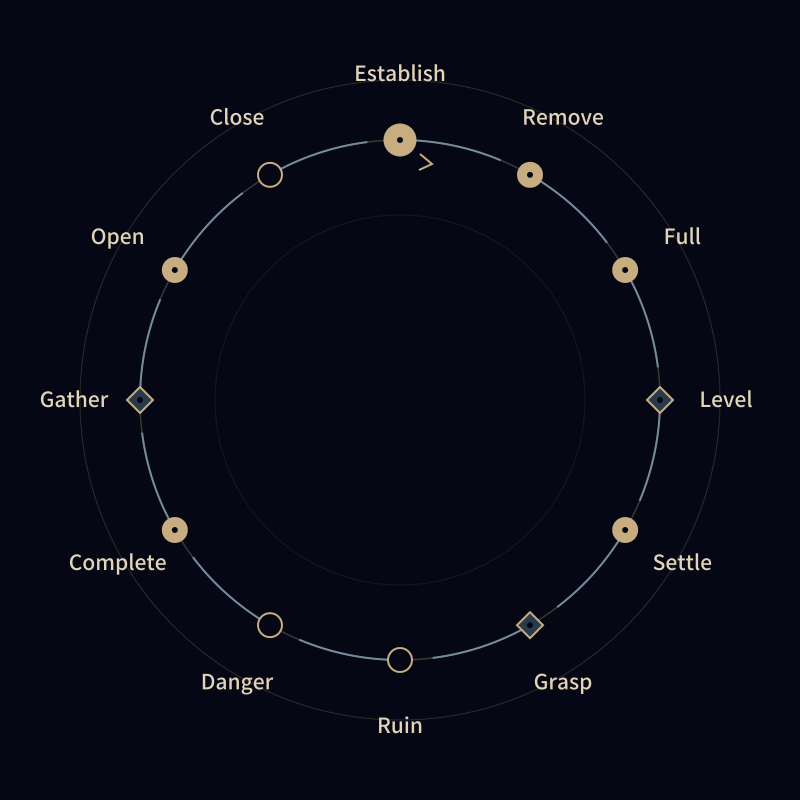
Twelve Day Officers
Read clockwise from 1 at the top. This shows sequence, not a date forecast; the starting day branch depends on the month branch.
● Auspicious · ○ Inauspicious · ◇ Neutral — traditional categories
- 1. Establish
- 2. Remove
- 3. Full
- 4. Level
- 5. Settle
- 6. Grasp
- 7. Ruin
- 8. Danger
- 9. Complete
- 10. Gather
- 11. Open
- 12. Close
建EstablishAuspicious
The day that raises — suited to founding and beginning.
The twelve Jianchu officers take the day whose branch matches the month branch as Establish (建), after which Remove, Full, Level, Settle, Grasp, Ruin, Danger, Complete, Gather, Open and Close follow in rotation. Establish, first in that turn, carries the grain of raising something up, so it suits openings, groundbreaking and enrolment. Because that founding force is strong, its energy is read as fierce — less fitting for quiet finishing or for taking something away.
- Suited to
- Opening · Groundbreaking · Beginnings
- Avoid
- Finishing · Demolition
除RemoveAuspicious
The day that clears away — suited to tidying and removing.
Remove carries the grain of clearing out what has grown stale. It suits cleaning, sorting and treatment — anything that takes something away — and is also used to close out matters that have dragged on. It is read as a day for making space rather than for launching something large.
- Suited to
- Clearing · Treatment · Cancelling
- Avoid
- Opening
滿FullAuspicious
The day that fills — suited to taking in and storing.
Full means brimming. It suits filling a storehouse, bringing goods in, saving and buying — anything that accumulates inward. Because it is already full, it is read as ill-matched to emptying out or sending away on a large scale.
- Suited to
- Purchase · Stocking · Saving
- Avoid
- Taking medicine · Demolition
平LevelNeutral
The day that evens out — neither notably good nor bad.
Level is a day whose grain lies flat. Being neither strongly auspicious nor inauspicious, it is read as sound for ordinary work and for evening things out rather than for a special occasion. In practice it simply means not going out of your way to avoid the day when the other signals are good.
- Suited to
- Routine work · Maintenance
定SettleAuspicious
The day that fixes — suited to firming up an agreement or taking a seat.
Settle carries the grain of pinning something down, so it suits contracts, betrothals and moving in — anything that fixes a position. Standing for stability, it is read as unsuited to work with large motion in it, and especially to litigation or disputes that shake the board.
- Suited to
- Contract · Betrothal · Moving in
- Avoid
- Litigation · Travel
執GraspNeutral
The day that holds — suited to keeping and securing.
Grasp means to hold in hand and keep. It is read as sound for concluding a contract, firming an agreement, or bringing someone on board. Because its grain holds on, it sits poorly with going far away or shifting on a large scale.
- Suited to
- Contract · Agreement · Hiring
- Avoid
- Moving house · Long travel
破RuinInauspicious
The day that breaks — not suited to anything you are starting.
Ruin is the officer whose grain breaks most roughly, seated directly opposite Establish. It is ill-suited to starting anything meant to last — a wedding, an opening, a move — and has traditionally been avoided firmly. It is, however, read as fitting for work whose purpose is breaking: demolition, clearing out something old, or bringing a relationship to a close.
- Suited to
- Demolition · Clearing out
- Avoid
- Wedding · Opening · Moving · Contract
危DangerInauspicious
The precarious day — avoid heights, long roads and anything with risk in it.
Danger means precarious. Climbing high, setting out on a long road and entering water have been avoided on it, and large occasions are not weighed favourably either. Work handled carefully, or set in order indoors, was not much minded.
- Avoid
- Long journeys · Climbing · Large occasions
成CompleteAuspicious
The day that accomplishes — the most widely favoured of the twelve for a large occasion.
Complete carries the grain of a matter coming to fruition and is, with Open, the most widely used auspicious officer of the twelve. It suits weddings, openings, moving in and contracts alike, and a day where Complete falls together with the Yellow Way has long been the first candidate for a large occasion. Conversely it is read as running against work that ends or removes something.
- Suited to
- Wedding · Opening · Moving in · Contract
- Avoid
- Demolition · Cancelling
收GatherNeutral
The day that harvests — suited to receiving and storing away.
Gather means to take in. It suits harvest, collection and receipts — anything received and stored. Because its grain gathers inward, it is read as ill-matched to launching something new, to sending outward, or to a funeral that sends someone away.
- Suited to
- Collection · Harvest · Receipts
- Avoid
- Opening · Long travel
開OpenAuspicious
The day that opens — suited to opening a door and setting out.
Open carries the grain of a door swinging wide, so it suits openings, inaugurations, enrolment and travel — anything that opens and goes forward. With Complete it is one of the two representative auspicious officers, and it is weighed especially highly when selecting a day to open a business. Because its grain opens, it does not suit a funeral, which closes and sends away.
- Suited to
- Opening · Inauguration · Enrolment · Travel
- Avoid
- Funeral
閉CloseInauspicious
The day that shuts — not suited to anything you are starting.
Close carries the grain of a door swinging shut and is the last seat of the twelve. It is ill-suited to newly opening anything — an opening, a wedding — and has been avoided for those. It is read, on the contrary, as fitting for work that blocks and seals: raising a bank, filling a hole, sealing something up.
- Suited to
- Sealing · Filling in
- Avoid
- Opening · Wedding · Inauguration
Selection stars
Son-free dayAuspicious
A Korean scheduling custom marked by lunar dates ending in 9 or 0.
A son-free day belongs to Korean customs for scheduling moves and ceremonies. The custom treats certain dates as free of the hindrance called 'son', so no travel direction is singled out on those dates. In MYEONG, the marker is set when the Korean lunar day ends in 9 or 0: days 9, 10, 19, 20, 29 and 30, with day 30 absent in a short month. It is considered alongside chart relations and the purpose of the event. It does not promise that an event will succeed or be safe.
- Suited to
- Moving house · Opening · Beginnings
三災Three CalamitiesInauspicious
A three-year span of caution that comes round once every twelve years.
The Three Calamities is a three-year span of caution that arrives once every twelve years, keyed to the branch of your birth year. The twelve branches are grouped into four trines, and each group has its three fixed years: those born under Shen-Zi-Chen meet it in Yin, Mao and Chen years, Yin-Wu-Xu in Shen, You and Xu, Si-You-Chou in Hai, Zi and Chou, and Hai-Mao-Wei in Si, Wu and Wei. The entering, dwelling and departing years are sometimes weighed differently. In date selection it lowers the score of a large occasion, but since three whole years cannot be left empty it is not read as 'do nothing' — it is closer to a signal to shift weight from starting something large toward holding what you already have.
- Avoid
- Large occasions · New expansion
天德貴人Heavenly Virtue NobleAuspicious
A day on which the virtue of heaven rests — broadly good for anything undertaken large.
Heavenly Virtue Noble is an auspicious star fixed by the month branch. Unlike the Heavenly Noble read in a natal chart, it is used chiefly **in choosing a day**. The virtue of heaven is held to descend on that day, so it is read as broadly good for weddings, openings, moves and raising a ridge beam, and as easing the weight of a harsh star that falls alongside. A day where it falls together with the Monthly Virtue Noble has long been held especially precious.
- Suited to
- Wedding · Opening · Moving · Large occasions
月德貴人Monthly Virtue NobleAuspicious
A day on which the virtue of the moon rests — held especially good for matters of the household.
Monthly Virtue Noble is likewise an auspicious selection star fixed by the month branch. If Heavenly Virtue is the virtue of heaven, this is the virtue of the moon, and it has traditionally been read as good above all for domestic matters — a wedding, moving in, repairs, anything touching home and dwelling — rather than for large affairs outside. A day on which both fall is called the Two Virtues of Heaven and Moon and is counted the soundest day in date selection.
- Suited to
- Wedding · Moving in · Repairs · Household matters
用神日Useful-element dayAuspicious
A day whose stem and branch supply what your own chart lacks.
A useful-element day is one on which the day's stem and branch bring the element (yongshen) your chart needs. Where the Yellow-and-Black Way and the Jianchu officers are properties of the calendar and therefore the same day for everyone, this one is **a different day for different people** — the same date supplies one person and means nothing to another. In date selection it is weighed heavily for an opening, where you must push your own energy forward. Conversely a day that feeds what harms the chart is weighed low. Which element counts as the useful one varies by school, so if elsewhere you are recommended a different day, this is usually where the difference lies.
- Suited to
- Opening · Important beginnings
用神逆行Counter-element dayInauspicious
A day whose stem and branch run against the element you need.
The far side of the useful-element day. Here the day's pillars work against the element your chart needs, so the energy does not carry you and matters are read as moving slowly. Like the useful-element day it is personal, so the same date is counter-running for one person and meaningless for another. Rather than avoiding it outright, it is enough to shift an important beginning by a day or two.
- Avoid
- Important beginnings
忌神日Hostile-element dayInauspicious
A day on which the element that burdens your chart grows stronger.
The hostile element (jishen) is the side of your chart already in excess, or the one that unbalances it. When the day's stem and branch feed that element further, your usual weak point is read as standing out more, so the score of a large occasion is lowered. Which element counts as useful and which as hostile varies by school, so a judgement elsewhere may differ; and here too it does not mean nothing can be done that day, only that it is not a day to force something through.
- Avoid
- Large occasions · Forcing something through
Frequently asked
- What is a son-free day?
- It is a Korean folk category used when arranging moves and ceremonies. MYEONG marks Korean lunar days ending in 9 or 0: 9, 10, 19, 20, 29 and 30, omitting day 30 in a short month. The marker reflects a custom about avoiding directional hindrance; chart relations and the event's purpose are considered as well.
- How do the Yellow Way and the Twelve Officers differ?
- Both are twelve-day rotations keyed to the month branch, but they answer different questions. The Yellow-and-Black Way says whether the day's grain runs smooth or clouded; the Twelve Officers say what the day is for — establishing, gathering, opening. In practice the first candidates are days where the two agree: a Yellow Way day on which the officer 'completes' (成) or 'opens' (開).
- Is a chosen date the same for everyone?
- Only partly. The Yellow-and-Black Way, the Twelve Officers and son-free days are properties of the calendar and therefore identical for everyone, while the unions, clashes, punishments and harms against your own chart, and the day that supplies your needed element, differ per person. That is why the same day can be excellent for one person and unremarkable for another.
- Must a clash day always be avoided?
- For occasions that are hard to undo, such as a wedding, it has traditionally been avoided firmly. But a clash is less a misfortune than a jolt that forces movement, so where something has stalled it can be read differently. What was clashed — and whether it helps or burdens your chart — changes the reading.
- Does the Three Calamities mean doing nothing for three years?
- No. It runs for three years once every twelve, and three whole years cannot be left empty. Traditionally it was read not as 'do nothing' but as a signal to shift weight from starting something large toward holding what you already have.
Want actual auspicious dates matched to your own chart?
Open date selection →This glossary organises the perspective of the traditional perpetual calendar for reference; it is not a verdict on any date. A day classed as inauspicious means only that it does not suit certain undertakings, not that nothing can be done.
Weddings, moves, openings — pick the day against your own chart.
Find my date →