Layers of time
From the long view to one day
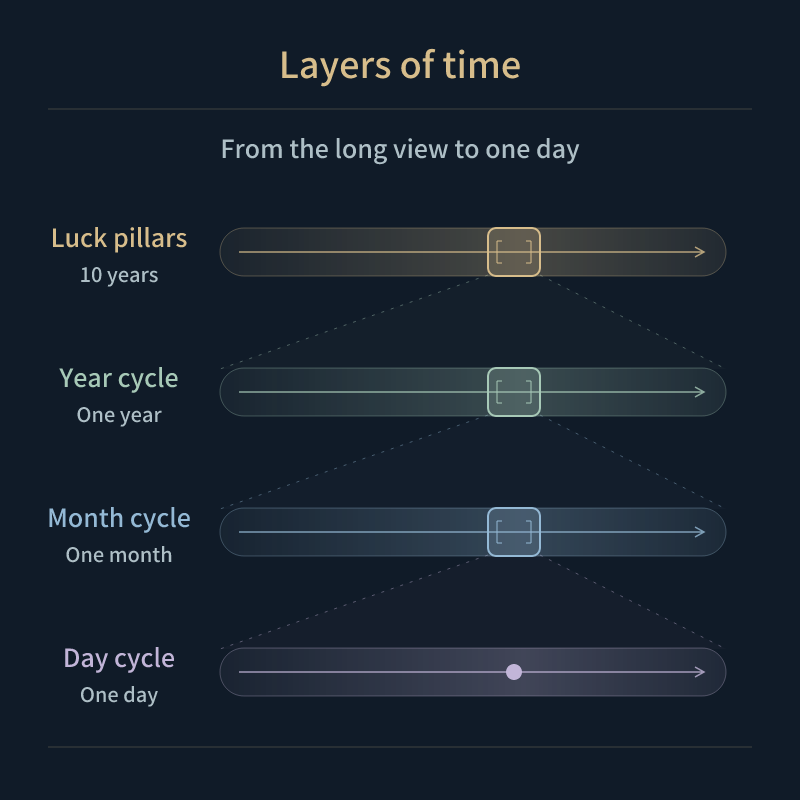
When each layer changes
- Luck pillars · 10 years
- The starting age is calculated from birth time and the interval to a solar-term boundary; it is not the same for everyone.
- Year cycle · One year
- The year cycle changes at the instant of Beginning of Spring, not January 1 or Lunar New Year.
- Month cycle · One month
- The month cycle changes at one of the twelve month-opening solar terms, not the first calendar day of the month.
- Day cycle · One day
- MYEONG's day cycle uses the date shown by the current instant in the birthplace time zone. One day does not override the natal chart and longer-term context.
Read about the four cycles
Luck pillars (大運)
The background current that turns every ten years, extending forward or backward from the month pillar.
The luck pillars are the background current that turns every ten years. If the natal chart is a map fixed at birth, the luck pillars are closer to the seasons passing over it. They are generated by stepping the sexagenary cycle forward or backward from the month pillar, with the direction set by the polarity of the birth year together with sex. The starting age is derived from the distance from the birth moment to the solar-term boundary. A change of luck pillar is read as a change in the background of a life, but it is not a prediction of events — it is a grain of influence, and the same pillar acts differently depending on how the natal chart is composed.
Year cycle (歲運)
The current that turns each year — where that year's pillar meets the natal chart.
The year cycle is the current that turns once a year. It is read from the Ten-God relation formed when that year's pillar meets the natal chart. If the luck pillar is a ten-year backdrop, the year cycle is the colour one year takes on top of it, and the two must be read layered — the same year acts differently depending on which luck pillar it falls on. One caveat: the boundary of a year cycle is neither January 1st nor lunar New Year but Lichun (立春), which MYEONG splits at the exact solar-term instant. A year cycle is not a forecast of events but the grain of a year.
Month cycle (月運)
The current that turns each month — bounded by the solar term, not the 1st.
The month cycle is the current that turns once a month. It is a layer where the colour shifts slightly from month to month inside the year cycle, so it is less a place for setting direction than for choosing timing. What matters is that its boundary is not the 1st of the calendar month but the solar-term entry — the month pillar turns at the month-opening term, generally near the beginning of the calendar month, so a single calendar month can carry two different grains. Being a fine ripple of the current, a month cycle does not overturn the natal chart or the luck pillar.
Day cycle (日運)
The current that turns daily — how that day's pillar meets the natal chart.
The day cycle is the current that turns once a day; that day's pillar is commonly called the day marker (日辰). Being the shallowest layer it does not set the direction of a life, but it is useful for choosing what to spend a given day on — whether it is a grain where words land well, or one better suited to sorting things out alone. Precisely because it is shallow, a day cycle cannot overturn what the natal chart, luck pillar and year cycle point to. It should not be used to pronounce a day lucky or unlucky — the same day pillar meets each person differently.
Source: reviewed BaZi framework glossary and MYEONG time-cycle conventions